Significantly improved precision of cell migration analysis in time-lapse video microscopy through use of a fully automated tracking system
Johannes Huth, Malte Buchholz, Johann M Kraus, Martin Schmucker, Götz von Wichert, Denis Krndija, Thomas Seufferlein, Thomas M Gress, Hans A Kestler
Abstract
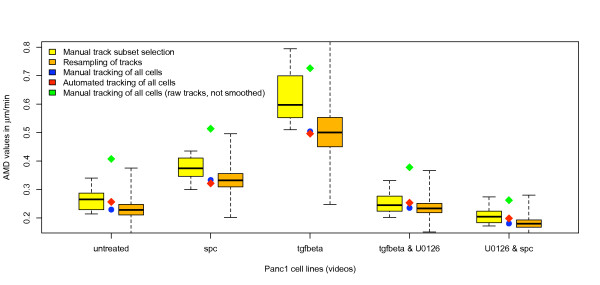
'Götz von Wichert' 'Denis Krndija' 'Thomas Seufferlein' 'Thomas M Gress' 'Hans A Kestler'] Background Cell motility is a critical parameter in many physiological as well as pathophysiological processes. In time-lapse video microscopy, manual cell tracking remains the most common method of analyzing migratory behavior of cell populations. In addition to being labor-intensive, this method is susceptible to user-dependent errors regarding the selection of "representative" subsets of cells and manual determination of precise cell positions. Results We have quantitatively analyzed these error sources, demonstrating that manual cell tracking of pancreatic cancer cells lead to mis-calculation of migration rates of up to 410%. In order to provide for objective measurements of cell migration rates, we have employed multi-target tracking technologies commonly used in radar applications to develop fully automated cell identification and tracking system suitable for high throughput screening of video sequences of unstained living cells. Conclusion We demonstrate that our automatic multi target tracking system identifies cell objects, follows individual cells and computes migration rates with high precision, clearly outperforming manual procedures.
§ The Valyu brief
Reading the full paper and taking notes. This takes a few seconds…
§ Ask this paper
Ask a question about this paper
Valyu reads the full text and answers from what the paper actually says.
Searching the other archives…