Analysis of Alzheimer's disease severity across brain regions by topological analysis of gene co-expression networks
Monika Ray, Weixiong Zhang
Abstract
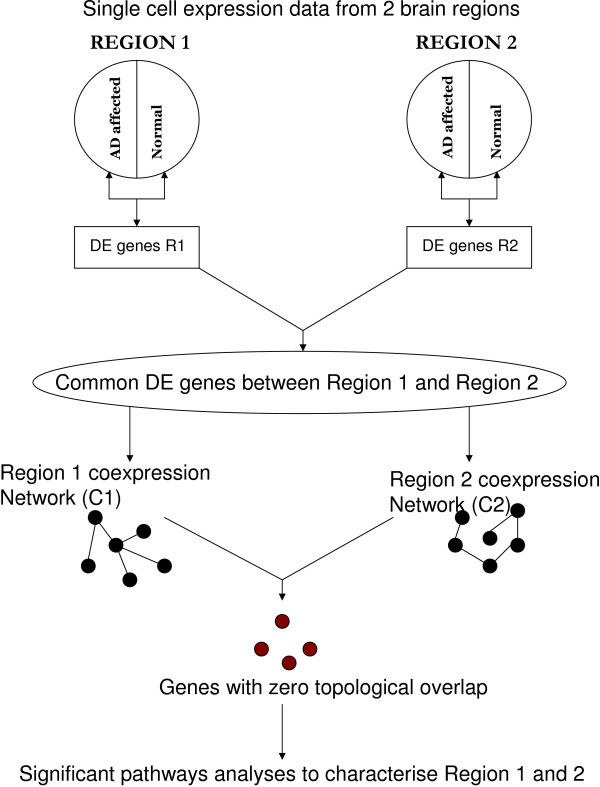
Background Alzheimer's disease (AD) is a progressive neurodegenerative disorder involving variations in the transcriptome of many genes. AD does not affect all brain regions simultaneously. Identifying the differences among the affected regions may shed more light onto the disease progression. We developed a novel method involving the differential topology of gene coexpression networks to understand the association among affected regions and disease severity. Methods We analysed microarray data of four regions - entorhinal cortex (EC), hippocampus (HIP), posterior cingulate cortex (PCC) and middle temporal gyrus (MTG) from AD affected and normal subjects. A coexpression network was built for each region and the topological overlap between them was examined. Genes with zero topological overlap between two region-specific networks were used to characterise the differences between the two regions. Results and conclusion Results indicate that MTG shows early AD pathology compared to the other regions. We postulate that if the MTG gets affected later in the disease, post-mortem analyses of individuals with end-stage AD will show signs of early AD in the MTG, while the EC, HIP and PCC will have severe pathology. Such knowledge is useful for data collection in clinical studies where sample selection is a limiting factor as well as highlighting the underlying biology of disease progression.
§ The Valyu brief
Reading the full paper and taking notes. This takes a few seconds…
§ Ask this paper
Ask a question about this paper
Valyu reads the full text and answers from what the paper actually says.
Searching the other archives…