Introduction of customized inserts for streamlined assembly and optimization of BioBrick synthetic genetic circuits
Julie E Norville, Ratmir Derda, Saurabh Gupta, Kelly A Drinkwater, Angela M Belcher, Andres E Leschziner, Thomas F Knight Jr
Abstract
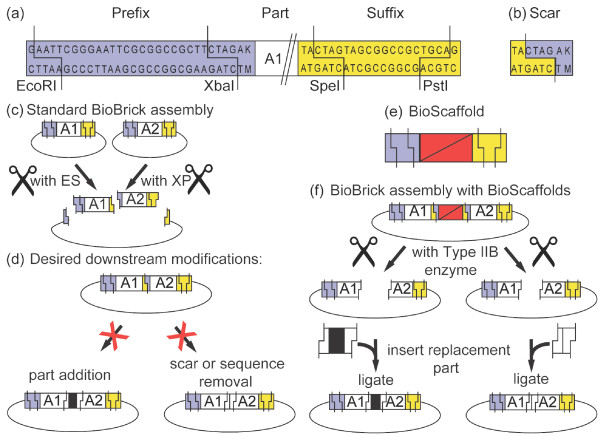
'Angela M Belcher' 'Andres E Leschziner' 'Thomas F Knight Jr'] Background BioBrick standard biological parts are designed to make biological systems easier to engineer (e.g. assemble, manipulate, and modify). There are over 5,000 parts available in the Registry of Standard Biological Parts that can be easily assembled into genetic circuits using a standard assembly technique. The standardization of the assembly technique has allowed for wide distribution to a large number of users -- the parts are reusable and interchangeable during the assembly process. The standard assembly process, however, has some limitations. In particular it does not allow for modification of already assembled biological circuits, addition of protein tags to pre-existing BioBrick parts, or addition of non-BioBrick parts to assemblies. Results In this paper we describe a simple technique for rapid generation of synthetic biological circuits using introduction of customized inserts. We demonstrate its use in Escherichia coli (E. coli) to express green fluorescent protein (GFP) at pre-calculated relative levels and to add an N-terminal tag to GFP. The technique uses a new BioBrick part (called a BioScaffold) that can be inserted into cloning vectors and excised from them to leave a gap into which other DNA elements can be placed. The removal of the BioScaffold is performed by a Type IIB restriction enzyme (REase) that recognizes the BioScaffold but cuts into the surrounding sequences; therefore, the placement and removal of the BioScaffold allows the creation of seamless connections between arbitrary DNA sequences in cloning vectors. The BioScaffold contains a built-in red fluorescent protein (RFP) reporter; successful insertion of the BioScaffold is, thus, accompanied by gain of red fluorescence and its removal is manifested by disappearance of the red fluorescence.
§ The Valyu brief
Reading the full paper and taking notes. This takes a few seconds…
§ Ask this paper
Ask a question about this paper
Valyu reads the full text and answers from what the paper actually says.
Searching the other archives…