Protein Complexes are Central in the Yeast Genetic Landscape The Monochromatic Landscape of the Yeast Cell
Magali Michaut, Anastasia Baryshnikova, Michael Costanzo, Chad L. Myers, Brenda J. Andrews, Charles Boone, Gary D. Bader, Christian von Mering
Abstract
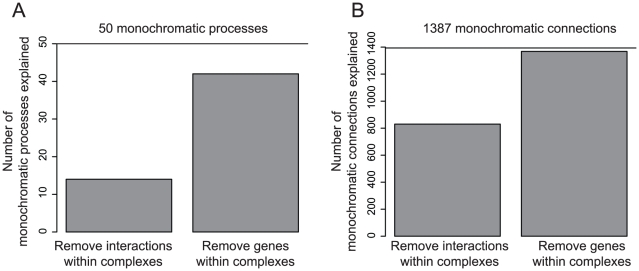
'Chad L. Myers' 'Brenda J. Andrews' 'Charles Boone' 'Gary D. Bader' 'Christian von Mering'] If perturbing two genes together has a stronger or weaker effect than expected, they are said to genetically interact. Genetic interactions are important because they help map gene function, and functionally related genes have similar genetic interaction patterns. Mapping quantitative (positive and negative) genetic interactions on a global scale has recently become possible. This data clearly shows groups of genes connected by predominantly positive or negative interactions, termed monochromatic groups. These groups often correspond to functional modules, like biological processes or complexes, or connections between modules. However it is not yet known how these patterns globally relate to known functional modules. Here we systematically study the monochromatic nature of known biological processes using the largest quantitative genetic interaction data set available, which includes fitness measurements for ∼5.4 million gene pairs in the yeast Saccharomyces cerevisiae. We find that only 10% of biological processes, as defined by Gene Ontology annotations, and less than 1% of inter-process connections are monochromatic. Further, we show that protein complexes are responsible for a surprisingly large fraction of these patterns. This suggests that complexes play a central role in shaping the monochromatic landscape of biological processes. Altogether this work shows that both positive and negative monochromatic patterns are found in known biological processes and in their connections and that protein complexes play an important role in these patterns. The monochromatic processes, complexes and connections we find chart a hierarchical and modular map of sensitive and redundant biological systems in the yeast cell that will be useful for gene function prediction and comparison across phenotypes and organisms. Furthermore the analysis methods we develop are applicable to other species for which genetic interactions will progressively become more available.
§ The Valyu brief
Reading the full paper and taking notes. This takes a few seconds…
§ Ask this paper
Ask a question about this paper
Valyu reads the full text and answers from what the paper actually says.
Searching the other archives…