Missing Data Approaches in eHealth Research: Simulation Study and a Tutorial for Nonmathematically Inclined Researchers
Gunther Eysenbach, Filip Smit, David Streiner, Matthijs Blankers, Maarten W J Koeter, Gerard M Schippers
Abstract
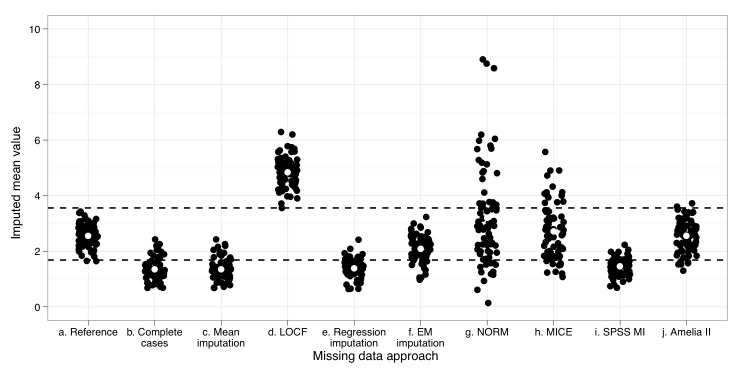
'Maarten W J Koeter' 'Gerard M Schippers'] Background Missing data is a common nuisance in eHealth research: it is hard to prevent and may invalidate research findings. Objective In this paper several statistical approaches to data “missingness” are discussed and tested in a simulation study. Basic approaches (complete case analysis, mean imputation, and last observation carried forward) and advanced methods (expectation maximization, regression imputation, and multiple imputation) are included in this analysis, and strengths and weaknesses are discussed. Methods The dataset used for the simulation was obtained from a prospective cohort study following participants in an online self-help program for problem drinkers. It contained 124 nonnormally distributed endpoints, that is, daily alcohol consumption counts of the study respondents. Missingness at random (MAR) was induced in a selected variable for 50% of the cases. Validity, reliability, and coverage of the estimates obtained using the different imputation methods were calculated by performing a bootstrapping simulation study. Results In the performed simulation study, the use of multiple imputation techniques led to accurate results. Differences were found between the 4 tested multiple imputation programs: NORM, MICE, Amelia II, and SPSS MI. Among the tested approaches, Amelia II outperformed the others, led to the smallest deviation from the reference value (Cohen’s d = 0.06), and had the largest coverage percentage of the reference confidence interval (96%). Conclusions The use of multiple imputation improves the validity of the results when analyzing datasets with missing observations. Some of the often-used approaches (LOCF, complete cases analysis) did not perform well, and, hence, we recommend not using these. Accumulating support for the analysis of multiple imputed datasets is seen in more recent versions of some of the widely used statistical software programs making the use of multiple imputation more readily available to less mathematically inclined researchers.
§ The Valyu brief
Reading the full paper and taking notes. This takes a few seconds…
§ Ask this paper
Ask a question about this paper
Valyu reads the full text and answers from what the paper actually says.
Searching the other archives…