Quantification of Trace-Level DNA by Real-Time Whole Genome Amplification DNA Quantification by Whole Genome Amplification
Min-Jung Kang, Hannah Yu, Sook-Kyung Kim, Sang-Ryoul Park, Inchul Yang, M. Thomas P. Gilbert
Abstract
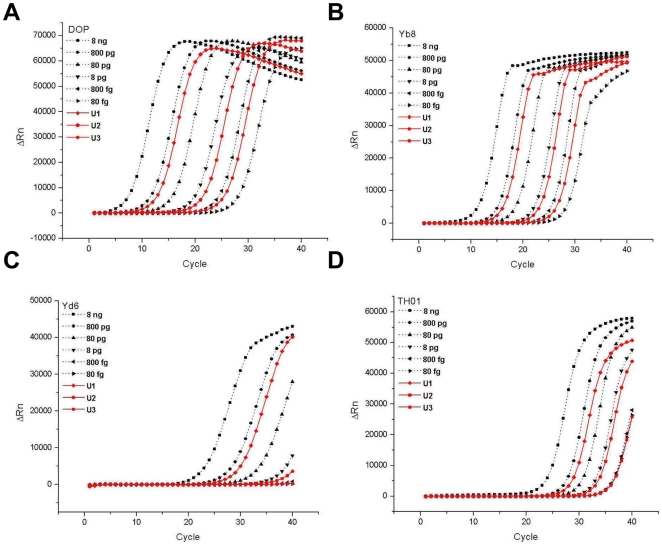
Quantification of trace amounts of DNA is a challenge in analytical applications where the concentration of a target DNA is very low or only limited amounts of samples are available for analysis. PCR-based methods including real-time PCR are highly sensitive and widely used for quantification of low-level DNA samples. However, ordinary PCR methods require at least one copy of a specific gene sequence for amplification and may not work for a sub-genomic amount of DNA. We suggest a real-time whole genome amplification method adopting the degenerate oligonucleotide primed PCR (DOP-PCR) for quantification of sub-genomic amounts of DNA. This approach enabled quantification of sub-picogram amounts of DNA independently of their sequences. When the method was applied to the human placental DNA of which amount was accurately determined by inductively coupled plasma-optical emission spectroscopy (ICP-OES), an accurate and stable quantification capability for DNA samples ranging from 80 fg to 8 ng was obtained. In blind tests of laboratory-prepared DNA samples, measurement accuracies of 7.4%, −2.1%, and −13.9% with analytical precisions around 15% were achieved for 400-pg, 4-pg, and 400-fg DNA samples, respectively. A similar quantification capability was also observed for other DNA species from calf, E. coli, and lambda phage. Therefore, when provided with an appropriate standard DNA, the suggested real-time DOP-PCR method can be used as a universal method for quantification of trace amounts of DNA.
§ The Valyu brief
Reading the full paper and taking notes. This takes a few seconds…
§ Ask this paper
Ask a question about this paper
Valyu reads the full text and answers from what the paper actually says.
Searching the other archives…