The Role of Attention in Ambiguous Reversals of Structure-From-Motion Attention and Ambiguous Reversals of SFM
Solveiga Stonkute, Jochen Braun, Alexander Pastukhov, Suliann Ben Hamed
Abstract
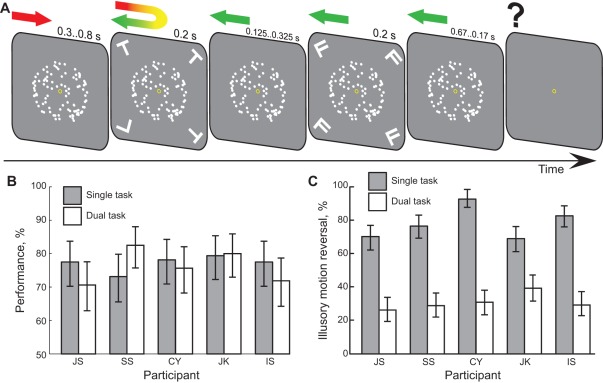
Multiple dots moving independently back and forth on a flat screen induce a compelling illusion of a sphere rotating in depth (structure-from-motion). If all dots simultaneously reverse their direction of motion, two perceptual outcomes are possible: either the illusory rotation reverses as well (and the illusory depth of each dot is maintained), or the illusory rotation is maintained (but the illusory depth of each dot reverses). We investigated the role of attention in these ambiguous reversals. Greater availability of attention - as manipulated with a concurrent task or inferred from eye movement statistics - shifted the balance in favor of reversing illusory rotation (rather than depth). On the other hand, volitional control over illusory reversals was limited and did not depend on tracking individual dots during the direction reversal. Finally, display properties strongly influenced ambiguous reversals. Any asymmetries between ‘front’ and ‘back’ surfaces - created either on purpose by coloring or accidentally by random dot placement - also shifted the balance in favor of reversing illusory rotation (rather than depth). We conclude that the outcome of ambiguous reversals depends on attention, specifically on attention to the illusory sphere and its surface irregularities, but not on attentive tracking of individual surface dots.
§ The Valyu brief
Reading the full paper and taking notes. This takes a few seconds…
§ Ask this paper
Ask a question about this paper
Valyu reads the full text and answers from what the paper actually says.
Searching the other archives…