Do the methods used to analyse missing data really matter? An examination of data from an observational study of Intermediate Care patients
Billingsley Kaambwa, Stirling Bryan, Lucinda Billingham
Abstract
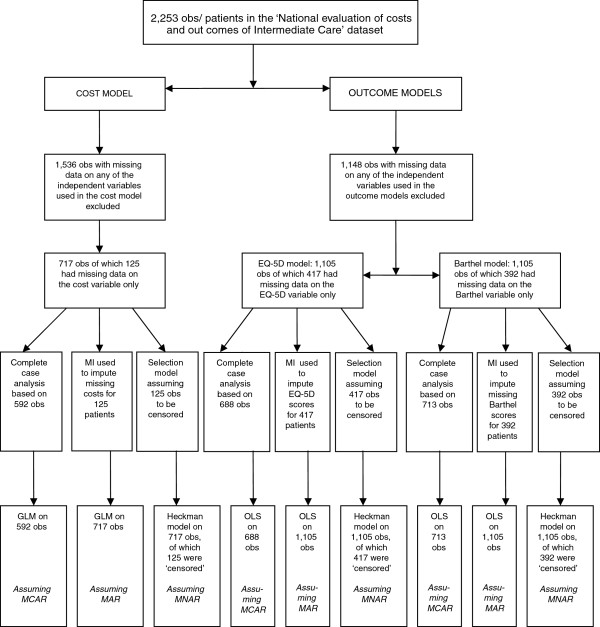
Background Missing data is a common statistical problem in healthcare datasets from populations of older people. Some argue that arbitrarily assuming the mechanism responsible for the missingness and therefore the method for dealing with this missingness is not the best option-but is this always true? This paper explores what happens when extra information that suggests that a particular mechanism is responsible for missing data is disregarded and methods for dealing with the missing data are chosen arbitrarily. Regression models based on 2,533 intermediate care (IC) patients from the largest evaluation of IC done and published in the UK to date were used to explain variation in costs, EQ-5D and Barthel index. Three methods for dealing with missingness were utilised, each assuming a different mechanism as being responsible for the missing data: complete case analysis (assuming missing completely at random-MCAR), multiple imputation (assuming missing at random-MAR) and Heckman selection model (assuming missing not at random-MNAR). Differences in results were gauged by examining the signs of coefficients as well as the sizes of both coefficients and associated standard errors. Results Extra information strongly suggested that missing cost data were MCAR. The results show that MCAR and MAR-based methods yielded similar results with sizes of most coefficients and standard errors differing by less than 3.4% while those based on MNAR-methods were statistically different (up to 730% bigger). Significant variables in all regression models also had the same direction of influence on costs. All three mechanisms of missingness were shown to be potential causes of the missing EQ-5D and Barthel data. The method chosen to deal with missing data did not seem to have any significant effect on the results for these data as they led to broadly similar conclusions with sizes of coefficients and standard errors differing by less than 54% and 322%, respectively. Conclusions Arbitrary selection of methods to deal with missing data should be avoided.
§ The Valyu brief
Reading the full paper and taking notes. This takes a few seconds…
§ Ask this paper
Ask a question about this paper
Valyu reads the full text and answers from what the paper actually says.
Searching the other archives…