Auditory Frequency and Intensity Discrimination Explained Using a Cortical Population Rate Code Cortical Rate Code for Pitch Discrimination
Christophe Micheyl, Paul R. Schrater, Andrew J. Oxenham, Timothy D. Griffiths
Abstract
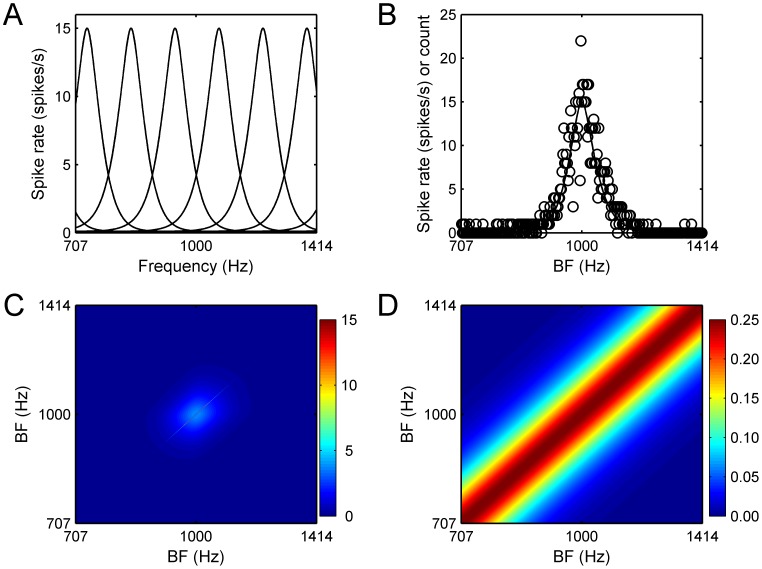
'Timothy D. Griffiths'] The nature of the neural codes for pitch and loudness, two basic auditory attributes, has been a key question in neuroscience for over century. A currently widespread view is that sound intensity (subjectively, loudness) is encoded in spike rates, whereas sound frequency (subjectively, pitch) is encoded in precise spike timing. Here, using information-theoretic analyses, we show that the spike rates of a population of virtual neural units with frequency-tuning and spike-count correlation characteristics similar to those measured in the primary auditory cortex of primates, contain sufficient statistical information to account for the smallest frequency-discrimination thresholds measured in human listeners. The same population, and the same spike-rate code, can also account for the intensity-discrimination thresholds of humans. These results demonstrate the viability of a unified rate-based cortical population code for both sound frequency (pitch) and sound intensity (loudness), and thus suggest a resolution to a long-standing puzzle in auditory neuroscience.
§ The Valyu brief
Reading the full paper and taking notes. This takes a few seconds…
§ Ask this paper
Ask a question about this paper
Valyu reads the full text and answers from what the paper actually says.
Searching the other archives…