Using Standard Optical Flow Cytometry for Synchronizing Proliferating Cells in the G1 Phase Size-Based Sorting for Purifying G1 Cells
Manuela Vecsler, Itay Lazar, Amit Tzur, Michael Polymenis
Abstract
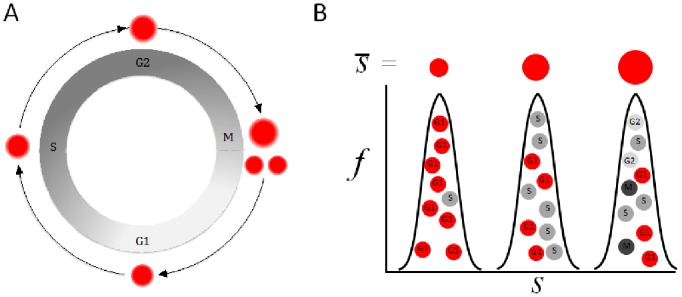
Cell cycle research greatly relies on synchronization of proliferating cells. However, effective synchronization of mammalian cells is commonly achieved by long exposure to one or more cell cycle blocking agents. These chemicals are, by definition, hazardous (some more than others), pose uneven cell cycle arrest, thus introducing unwanted variables. The challenge of synchronizing proliferating cells in G1 is even greater; this process typically involves the release of drug-arrested cells into the cycle that follows, a heterogeneous process that can truly limit synchronization. Moreover, drug-based synchronization decouples the cell cycle from cell growth in ways that are understudied and intolerable for those who investigate the relationship between these two processes. In this study we showed that cell size, as approximated by a single light-scatter parameter available in all standard sorters, can be used for synchronizing proliferating mammalian cells in G1 with minimal or no risk to either the cell cycle or cell growth. The power and selectivity of our method are demonstrated for human HEK293 cells that, despite their many advantages, are suboptimal for synchronization, let alone in G1. Our approach is readily available, simple, fast, and inexpensive; it is independent of any drugs or dyes, and nonhazardous. These properties are relevant for the study of the mammalian cell cycle, specifically in the context of G1 and cell growth.
§ The Valyu brief
Reading the full paper and taking notes. This takes a few seconds…
§ Ask this paper
Ask a question about this paper
Valyu reads the full text and answers from what the paper actually says.
Searching the other archives…