Disease Mapping and Regression with Count Data in the Presence of Overdispersion and Spatial Autocorrelation: A Bayesian Model Averaging Approach
Mohammadreza Mohebbi, Rory Wolfe, Andrew Forbes
Abstract
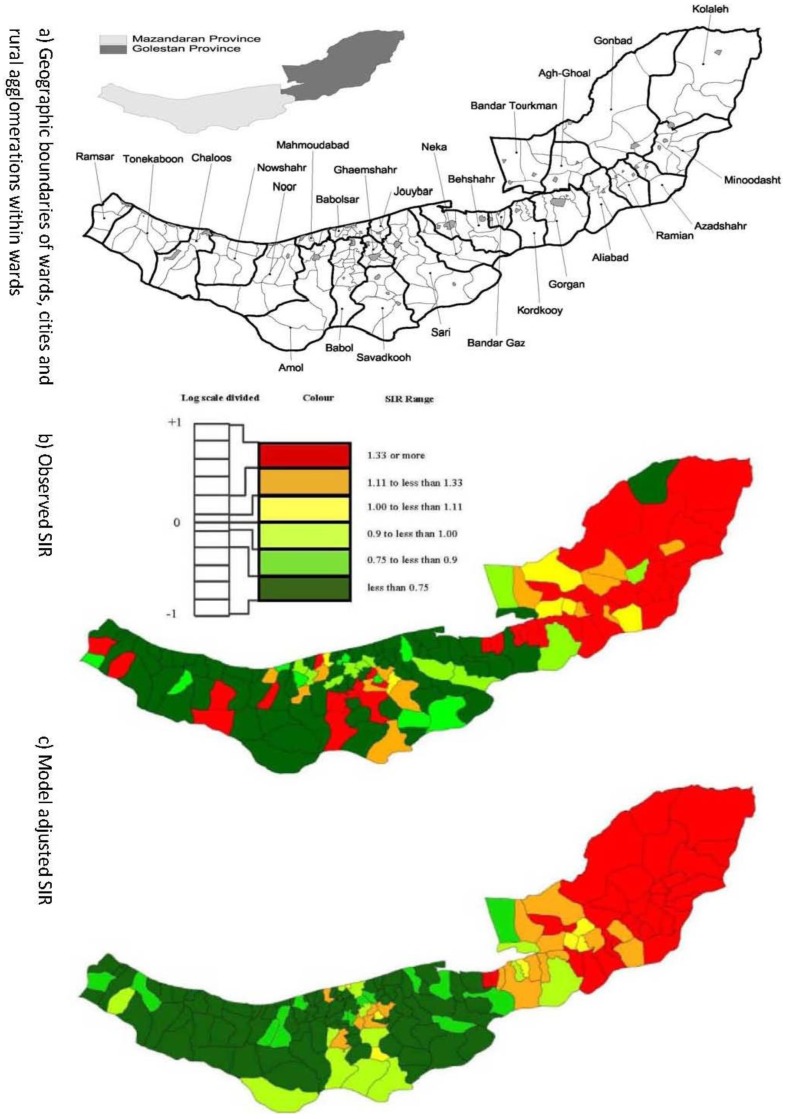
This paper applies the generalised linear model for modelling geographical variation to esophageal cancer incidence data in the Caspian region of Iran. The data have a complex and hierarchical structure that makes them suitable for hierarchical analysis using Bayesian techniques, but with care required to deal with problems arising from counts of events observed in small geographical areas when overdispersion and residual spatial autocorrelation are present. These considerations lead to nine regression models derived from using three probability distributions for count data: Poisson, generalised Poisson and negative binomial, and three different autocorrelation structures. We employ the framework of Bayesian variable selection and a Gibbs sampling based technique to identify significant cancer risk factors. The framework deals with situations where the number of possible models based on different combinations of candidate explanatory variables is large enough such that calculation of posterior probabilities for all models is difficult or infeasible. The evidence from applying the modelling methodology suggests that modelling strategies based on the use of generalised Poisson and negative binomial with spatial autocorrelation work well and provide a robust basis for inference.
§ The Valyu brief
Reading the full paper and taking notes. This takes a few seconds…
§ Ask this paper
Ask a question about this paper
Valyu reads the full text and answers from what the paper actually says.
Searching the other archives…