Lord’s Paradox in a Continuous Setting and a Regression Artifact in Numerical Cognition Research A Regression Artifact
Kimmo Eriksson, Olle Häggström, Robert J. van Beers
Abstract
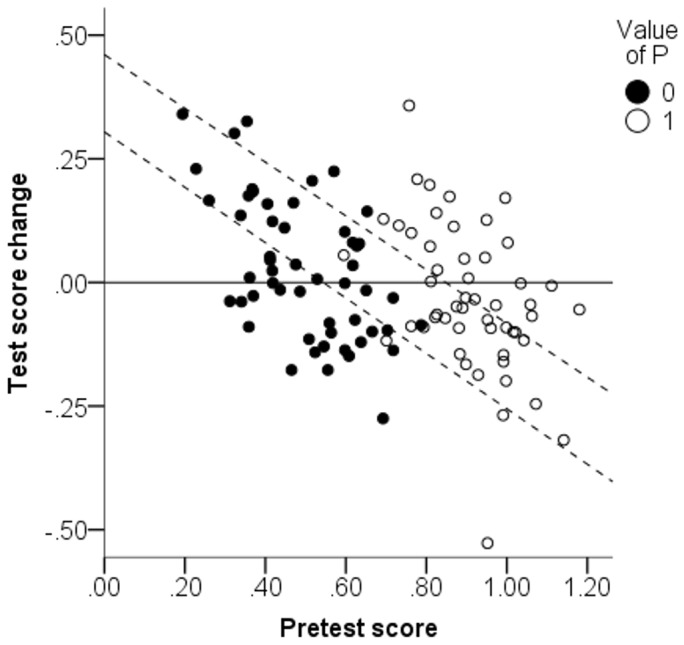
In this paper we review, and elaborate on, the literature on a regression artifact related to Lord’s paradox in a continuous setting. Specifically, the question is whether a continuous property of individuals predicts improvement from training between a pretest and a posttest. If the pretest score is included as a covariate, regression to the mean will lead to biased results if two critical conditions are satisfied: (1) the property is correlated with pretest scores and (2) pretest scores include random errors. We discuss how these conditions apply to the analysis in a published experimental study, the authors of which concluded that linearity of children’s estimations of numerical magnitudes predicts arithmetic learning from a training program. However, the two critical conditions were clearly met in that study. In a reanalysis we find that the bias in the method can fully account for the effect found in the original study. In other words, data are consistent with the null hypothesis that numerical magnitude estimations are unrelated to arithmetic learning.
§ The Valyu brief
Reading the full paper and taking notes. This takes a few seconds…
§ Ask this paper
Ask a question about this paper
Valyu reads the full text and answers from what the paper actually says.
Searching the other archives…