The evolutionary history of holometabolous insects inferred from transcriptome-based phylogeny and comprehensive morphological data
Ralph S Peters, Karen Meusemann, Malte Petersen, Christoph Mayer, Jeanne Wilbrandt, Tanja Ziesmann, Alexander Donath, Karl M Kjer, Ulrike Aspöck, Horst Aspöck, Andre Aberer, Alexandros Stamatakis, Frank Friedrich, Frank Hünefeld, Oliver Niehuis, Rolf G Beutel, Bernhard Misof
Abstract
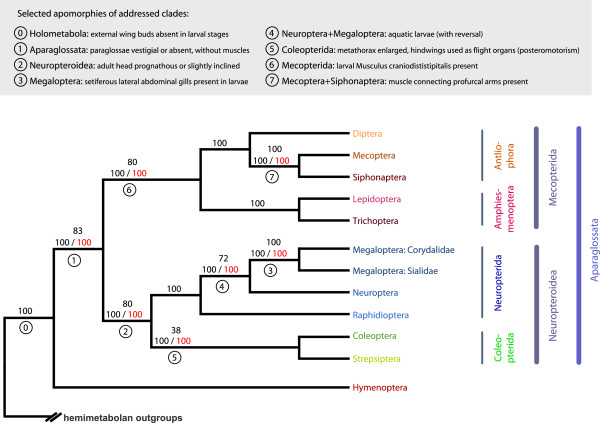
'Jeanne Wilbrandt' 'Tanja Ziesmann' 'Alexander Donath' 'Karl M Kjer' 'Ulrike Aspöck' 'Horst Aspöck' 'Andre Aberer' 'Alexandros Stamatakis' 'Frank Friedrich' 'Frank Hünefeld' 'Oliver Niehuis' 'Rolf G Beutel' 'Bernhard Misof'] Background Despite considerable progress in systematics, a comprehensive scenario of the evolution of phenotypic characters in the mega-diverse Holometabola based on a solid phylogenetic hypothesis was still missing. We addressed this issue by de novo sequencing transcriptome libraries of representatives of all orders of holometabolan insects (13 species in total) and by using a previously published extensive morphological dataset. We tested competing phylogenetic hypotheses by analyzing various specifically designed sets of amino acid sequence data, using maximum likelihood (ML) based tree inference and Four-cluster Likelihood Mapping (FcLM). By maximum parsimony-based mapping of the morphological data on the phylogenetic relationships we traced evolutionary transformations at the phenotypic level and reconstructed the groundplan of Holometabola and of selected subgroups. Results In our analysis of the amino acid sequence data of 1,343 single-copy orthologous genes, Hymenoptera are placed as sister group to all remaining holometabolan orders, i.e., to a clade Aparaglossata, comprising two monophyletic subunits Mecopterida (Amphiesmenoptera + Antliophora) and Neuropteroidea (Neuropterida + Coleopterida). The monophyly of Coleopterida (Coleoptera and Strepsiptera) remains ambiguous in the analyses of the transcriptome data, but appears likely based on the morphological data. Highly supported relationships within Neuropterida and Antliophora are Raphidioptera + (Neuroptera + monophyletic Megaloptera), and Diptera + (Siphonaptera + Mecoptera). ML tree inference and FcLM yielded largely congruent results. However, FcLM, which was applied here for the first time to large phylogenomic supermatrices, displayed additional signal in the datasets that was not identified in the ML trees.
§ The Valyu brief
Reading the full paper and taking notes. This takes a few seconds…
§ Ask this paper
Ask a question about this paper
Valyu reads the full text and answers from what the paper actually says.
Searching the other archives…