Hybrid coexpression link similarity graph clustering for mining biological modules from multiple gene expression datasets
Saeed Salem, Cagri Ozcaglar
Abstract
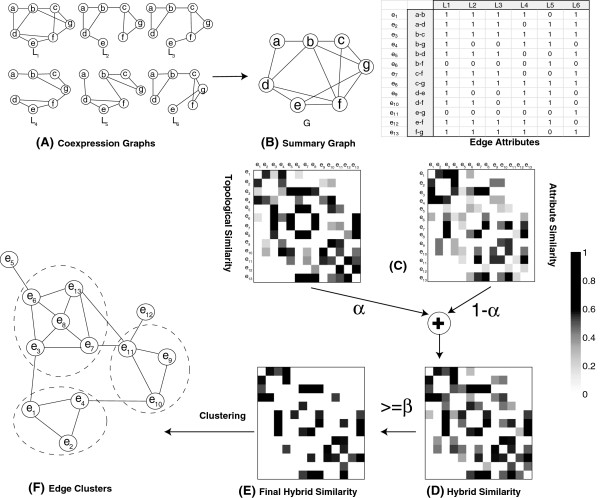
Background Advances in genomic technologies have enabled the accumulation of vast amount of genomic data, including gene expression data for multiple species under various biological and environmental conditions. Integration of these gene expression datasets is a promising strategy to alleviate the challenges of protein functional annotation and biological module discovery based on a single gene expression data, which suffers from spurious coexpression. Results We propose a joint mining algorithm that constructs a weighted hybrid similarity graph whose nodes are the coexpression links. The weight of an edge between two coexpression links in this hybrid graph is a linear combination of the topological similarities and co-appearance similarities of the corresponding two coexpression links. Clustering the weighted hybrid similarity graph yields recurrent coexpression link clusters (modules). Experimental results on Human gene expression datasets show that the reported modules are functionally homogeneous as evident by their enrichment with biological process GO terms and KEGG pathways.
§ The Valyu brief
Reading the full paper and taking notes. This takes a few seconds…
§ Ask this paper
Ask a question about this paper
Valyu reads the full text and answers from what the paper actually says.
Searching the other archives…