Molecular phylogenetic analyses support the monophyly of Hexapoda and suggest the paraphyly of Entognatha
Go Sasaki, Keisuke Ishiwata, Ryuichiro Machida, Takashi Miyata, Zhi-Hui Su
Abstract
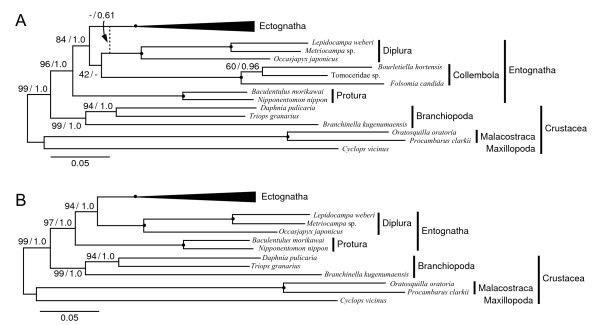
Background Molecular phylogenetic analyses have revealed that Hexapoda and Crustacea form a common clade (the Pancrustacea), which is now widely accepted among zoologists; however, the origin of Hexapoda remains unresolved. The main problems are the unclear relationships among the basal hexapod lineages, Protura (proturans), Collembola (springtails), Diplura (diplurans), and Ectognatha (bristletails, silverfishes, and all winged insects). Mitogenomic analyses have challenged hexapod monophyly and suggested the reciprocal paraphyly of Hexapoda and Crustacea, whereas studies based on nuclear molecular data support the monophyletic origin of hexapods. Additionally, there are significant discrepancies with respect to these issues between the results of morphological and molecular studies. To investigate these problems, we performed phylogenetic analyses of Pancrustacea based on the protein sequences of three orthologous nuclear genes encoding the catalytic subunit of DNA polymerase delta and the largest and second largest subunits of RNA polymerase II from 64 species of arthropods, including representatives of all hexapod orders. Results Phylogenetic analyses were conducted based on the inferred amino acid (aa) sequences (~3400 aa in total) of the three genes using the maximum likelihood (ML) method and Bayesian inference. Analyses were also performed with additional datasets generated by excluding long-branch taxa or by using different outgroups. These analyses all yielded essentially the same results. All hexapods were clustered into a common clade, with Branchiopoda as its sister lineage, whereas Crustacea was paraphyletic. Within Hexapoda, the lineages Ectognatha, Palaeoptera, Neoptera, Polyneoptera, and Holometabola were each confirmed to be monophyletic with robust support, but monophyly was not supported for Entognatha (Protura + Collembola + Diplura), Ellipura (Protura + Collembola), or Nonoculata (Protura + Diplura). Instead, our results showed that Protura is the sister lineage to all other hexapods and that Diplura or Diplura + Collembola is closely related to Ectognatha.
§ The Valyu brief
Reading the full paper and taking notes. This takes a few seconds…
§ Ask this paper
Ask a question about this paper
Valyu reads the full text and answers from what the paper actually says.
Searching the other archives…