Comparative effectiveness and safety of rituximab versus subsequent anti–tumor necrosis factor therapy in patients with rheumatoid arthritis with prior exposure to anti–tumor necrosis factor therapies in the United States Corrona registry
Leslie R. Harrold, George W. Reed, Robert Magner, Ashwini Shewade, Ani John, Jeffrey D. Greenberg, Joel M. Kremer
Abstract
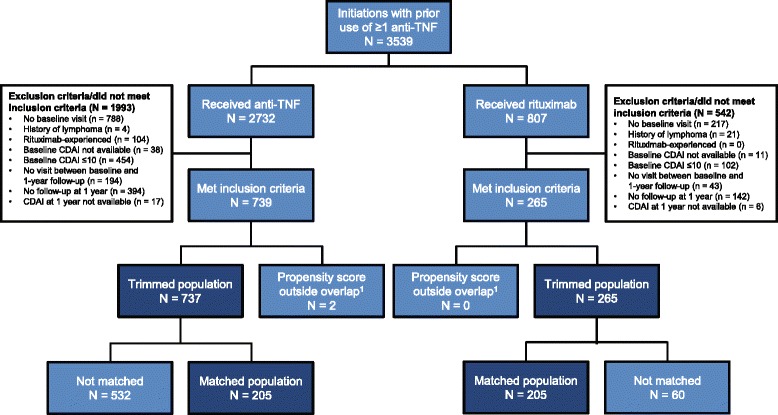
'Ani John' 'Jeffrey D. Greenberg' 'Joel M. Kremer'] Introduction Patients with active rheumatoid arthritis (RA) despite anti-tumor necrosis factor(anti-TNF)agent treatment can switch to either a subsequent anti-TNF agent or a biologic with an alternative mechanism of action, such as rituximab; however, there are limited data available to help physicians decide between these 2 strategies. The objective of this analysis was to examine the effectiveness and safety of rituximab versus a subsequent anti-TNF agent in anti-TNF-experienced patients with RA using clinical practice data from the Corrona registry. Methods Rituximab-naive patients from the Corrona registry with prior exposure to ≥1 anti-TNF agent who initiated rituximab or anti-TNF agents (2/28/2006-10/31/2012) were included. Two cohorts were analyzed: the trimmed population (excluding patients who fell outside the propensity score distribution overlap) and the stratified-matched population (stratified by 1 vs ≥2 anti-TNF agents, then matched based on propensity score). The primary effectiveness outcome was achievement of low disease activity (LDA)/remission (Clinical Disease Activity Index ≤10) at 1 year. Secondary outcomes included achievement of modified American College of Rheumatology (mACR) 20/50/70 responses and meaningful improvement (≥0.25) in modified Health Assessment Questionnaire (mHAQ) score at 1 year. New cardiovascular, infectious and cancer events were reported. Results Estimates for LDA/remission, mACR response and mHAQ improvement were consistently better for rituximab than for anti-TNF agent users in adjusted analyses. The odds ratio for likelihood of LDA/remission in rituximab versus anti-TNF patients was 1.35 (95 % CI, 0.95-1.91) in the trimmed population and 1.54 (95 % CI, 1.01-2.35) in the stratified-matched population. Rituximab patients were significantly more likely than anti-TNF patients to achieve mACR20/50 and mHAQ improvement in the trimmed population and mACR20 and mHAQ in the stratified-matched population. The rate of new adverse events per 100 patient-years was similar between groups.
§ The Valyu brief
Reading the full paper and taking notes. This takes a few seconds…
§ Ask this paper
Ask a question about this paper
Valyu reads the full text and answers from what the paper actually says.
Searching the other archives…