A new method for the extraction of fetal ECG from the dependent abdominal signals using blind source separation and adaptive noise cancellation techniques
Abdelghani Ghazdali, Abdelilah Hakim, Amine Laghrib, Nezha Mamouni, Said Raghay
Abstract
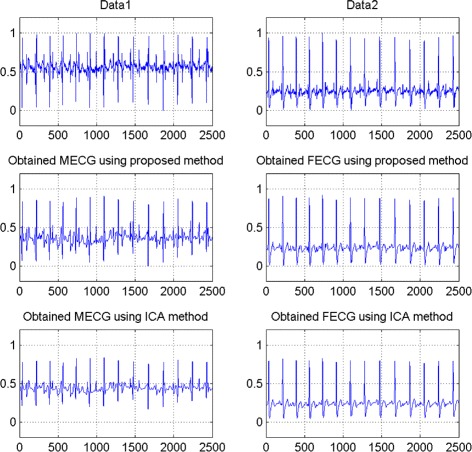
'Said Raghay'] Background The electrocardiogram (ECG) is a diagnostic tool that records the electrical activity of the heart, and depicts it as a series of graph-like tracings, or waves. Being able to interpret these details allows diagnosis of a wide range of heart problems. Fetal electrocardiogram (FECG) extraction has an important impact in medical diagnostics during the mother pregnancy period. Since the observed FECG signals are often mixed with the maternal ECG (MECG) and the noise induced by the movement of electrodes or by mother motion, the separation process of the ECG signal sources from the observed data becomes quite complicated. One of its complexity is when the ECG sources are dependent, thus, in this paper we introduce a new approach of blind source separation (BSS) in the noisy context for both independent and dependent ECG signal source. This approach consist in denoising the observed ECG signals using a bilateral total variation (BTV) filter; then minimizing the Kullbak-Leibler divergence between copula densities to separate the FECG signal from the MECG one. Results We present simulation results illustrating the performance of our proposed method. We will consider many examples of independent/dependent source component signals. The results will be compared with those of the classical method called independent component analysis (ICA) under the same conditions. The accuracy of source estimation is evaluated through a criterion, called again the signal-to-noise-ratio (SNR). The first experiment shows that our proposed method gives accurate estimation of sources in the standard case of independent components, with performance around 27 dB in term of SNR. In the second experiment, we show the capability of the proposed algorithm to successfully separate two noisy mixtures of dependent source components - with classical criterion devoted to the independent case - fails, and that our method is able to deal with the dependent case with good performance. Conclusions In this work, we focus specifically on the separation of the ECG signal sources taken from skin two electrodes located on a pregnant woman’s body.
§ The Valyu brief
Reading the full paper and taking notes. This takes a few seconds…
§ Ask this paper
Ask a question about this paper
Valyu reads the full text and answers from what the paper actually says.
Searching the other archives…