Screen detection of ductal carcinoma in situ and subsequent incidence of invasive interval breast cancers: a retrospective population-based study
Stephen W Duffy, Amanda Dibden, Dimitrios Michalopoulos, Judith Offman, Dharmishta Parmar, Jacquie Jenkins, Beverley Collins, Tony Robson, Suzanne Scorfield, Kathryn Green, Clare Hall, Xiao-Hui Liao, Michael Ryan, Fiona Johnson, Guy Stevens, Olive Kearins, Sarah Sellars, Julietta Patnick
Abstract
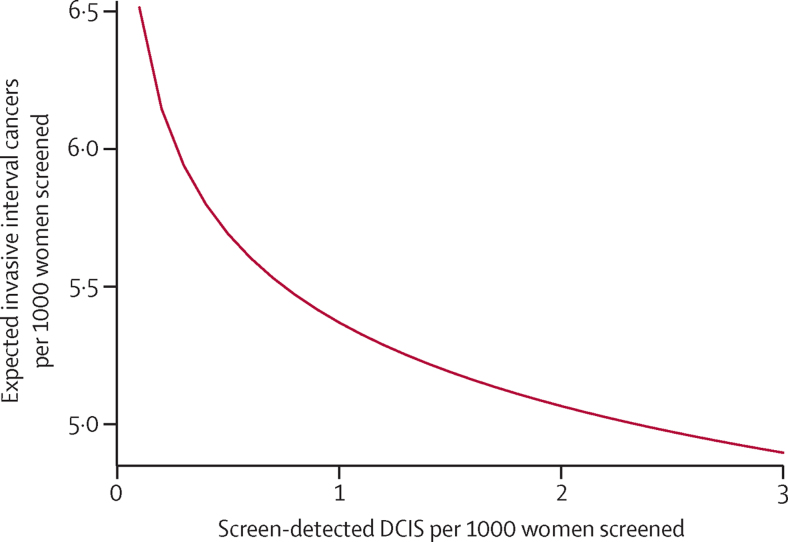
Title: Summary Background The value of screen detection and treatment of ductal carcinoma in situ (DCIS) is a matter of controversy. At present, the extent to which the diagnosis and treatment of DCIS could prevent the occurrence of invasive breast cancer in the future is not clear. We sought to estimate the association between detection of DCIS at screening and invasive interval cancers subsequent to the relevant screen. Methods We obtained aggregate data for screen-detected cancers from 84 local screening units within 11 regional Quality Assurance Reference Centres in England, Wales, and Northern Ireland from the National Health Service Breast Screening Programme. Data for DCIS diagnoses were obtained for women aged 50-64 years who were invited to and attended mammographic breast screening from April 1, 2003, to March 31, 2007 (4 screening years). Patient-level data for interval cancer arising in the 36 months after each of these were analysed by Poisson regression with invasive interval cancer screen detection rate as the outcome variable; DCIS detection frequencies were fitted first as a continuous and then as a categorical variable. We repeated this analysis after adjustment with both small size and high-grade invasive screen-detected cancers. Findings We analysed data for 5 243 658 women and on interval cancers occurring in the 36 months after the relevant screen. The average frequency of DCIS detected at screening was 1·60 per 1000 women screened (median 1·50 [unit range 1·54-3·56] per 1000 women). There was a significant negative association of screen-detected DCIS cases with the rate of invasive interval cancers (Poisson regression coefficient −0·084 [95% CI −0·13 to −0·03]; p=0·002). 90% of units had a DCIS detection frequency within the range of 1·00 to 2·22 per 1000 women; in these units, for every three screen-detected cases of DCIS, there was one fewer invasive interval cancer in the next 3 years. This association remained after adjustment for numbers of small screen-detected invasive cancers and for numbers of grade 3 invasive screen-detected cancers.
§ The Valyu brief
Reading the full paper and taking notes. This takes a few seconds…
§ Ask this paper
Ask a question about this paper
Valyu reads the full text and answers from what the paper actually says.
Searching the other archives…