Measuring Spatial Dependence for Infectious Disease Epidemiology Measures of Spatial Dependence in Epidemiology
Justin Lessler, Henrik Salje, M. Kate Grabowski, Derek A. T. Cummings, Michiel van Boven
Abstract
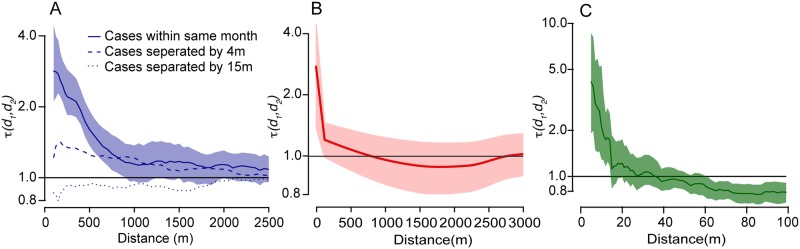
'Derek A. T. Cummings' 'Michiel van Boven'] Global spatial clustering is the tendency of points, here cases of infectious disease, to occur closer together than expected by chance. The extent of global clustering can provide a window into the spatial scale of disease transmission, thereby providing insights into the mechanism of spread, and informing optimal surveillance and control. Here the authors present an interpretable measure of spatial clustering, τ, which can be understood as a measure of relative risk. When biological or temporal information can be used to identify sets of potentially linked and likely unlinked cases, this measure can be estimated without knowledge of the underlying population distribution. The greater our ability to distinguish closely related (i.e., separated by few generations of transmission) from more distantly related cases, the more closely τ will track the true scale of transmission. The authors illustrate this approach using examples from the analyses of HIV, dengue and measles, and provide an R package implementing the methods described. The statistic presented, and measures of global clustering in general, can be powerful tools for analysis of spatially resolved data on infectious diseases.
§ The Valyu brief
Reading the full paper and taking notes. This takes a few seconds…
§ Ask this paper
Ask a question about this paper
Valyu reads the full text and answers from what the paper actually says.
Searching the other archives…