Brain response pattern identification of fMRI data using a particle swarm optimization-based approach
Xinpei Ma, Chun-An Chou, Hiroki Sayama, Wanpracha Art Chaovalitwongse
Abstract
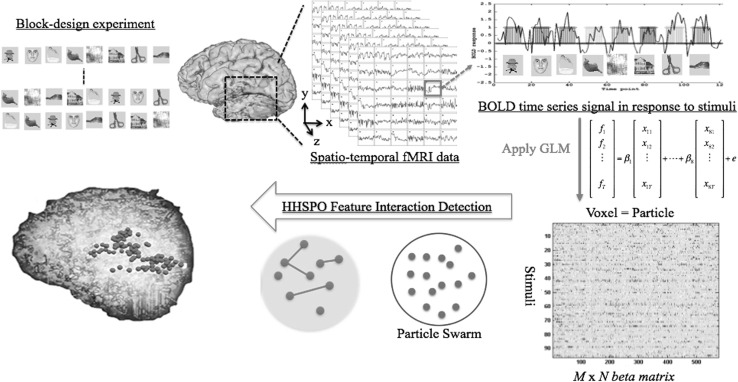
'Wanpracha Art Chaovalitwongse'] Many neuroscience studies have been devoted to understand brain neural responses correlating to cognition using functional magnetic resonance imaging (fMRI). In contrast to univariate analysis to identify response patterns, it is shown that multi-voxel pattern analysis (MVPA) of fMRI data becomes a relatively effective approach using machine learning techniques in the recent literature. MVPA can be considered as a multi-objective pattern classification problem with the aim to optimize response patterns, in which informative voxels interacting with each other are selected, achieving high classification accuracy associated with cognitive stimulus conditions. To solve the problem, we propose a feature interaction detection framework, integrating hierarchical heterogeneous particle swarm optimization and support vector machines, for voxel selection in MVPA. In the proposed approach, we first select the most informative voxels and then identify a response pattern based on the connectivity of the selected voxels. The effectiveness of the proposed approach was examined for the Haxby’s dataset of object-level representations. The computational results demonstrated higher classification accuracy by the extracted response patterns, compared to state-of-the-art feature selection algorithms, such as forward selection and backward selection.
§ The Valyu brief
Reading the full paper and taking notes. This takes a few seconds…
§ Ask this paper
Ask a question about this paper
Valyu reads the full text and answers from what the paper actually says.
Searching the other archives…