Age-Related Differences of Individuals’ Arithmetic Strategy Utilization with Different Level of Math Anxiety
Jiwei Si, Hongxia Li, Yan Sun, Yanli Xu, Yu Sun
Abstract
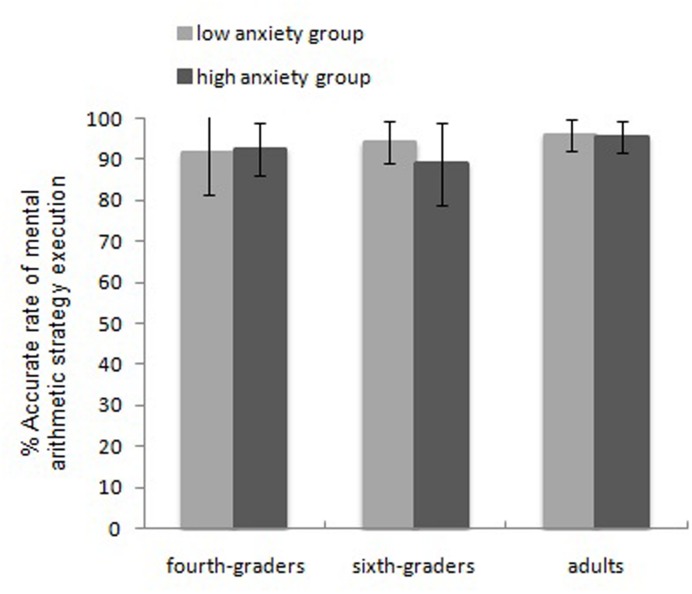
The present study used the choice/no-choice method to investigate the effect of math anxiety on the strategy used in computational estimation and mental arithmetic tasks and to examine age-related differences in this regard. Fifty-seven fourth graders, 56 sixth graders, and 60 adults were randomly selected to participate in the experiment. Results showed the following: (1) High-anxious individuals were more likely to use a rounding-down strategy in the computational estimation task under the best-choice condition. Additionally, sixth-grade students and adults performed faster than fourth-grade students on the strategy execution parameter. Math anxiety affected response times (RTs) and the accuracy with which strategies were executed. (2) The execution of the partial-decomposition strategy was superior to that of the full-decomposition strategy on the mental arithmetic task. Low-math-anxious persons provided more accurate answers than did high-math-anxious participants under the no-choice condition. This difference was significant for sixth graders. With regard to the strategy selection parameter, the RTs for strategy selection varied with age.
§ The Valyu brief
Reading the full paper and taking notes. This takes a few seconds…
§ Ask this paper
Ask a question about this paper
Valyu reads the full text and answers from what the paper actually says.
Searching the other archives…