The magnitude and temporal changes of response in the placebo arm of surgical randomized controlled trials: a systematic review and meta-analysis
Karolina A. Wartolowska, Benjamin G. Feakins, Gary S. Collins, Jonathan Cook, Andrew Judge, Ines Rombach, Benjamin J. F. Dean, James A. Smith, Andrew J. Carr
Abstract
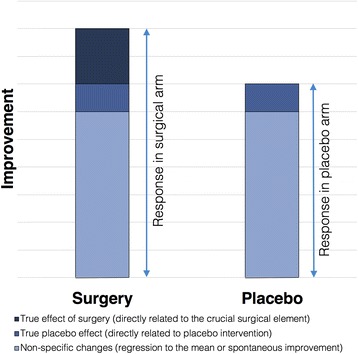
'Jonathan Cook' 'Andrew Judge' 'Ines Rombach' 'Benjamin J. F. Dean' 'James A. Smith' 'Andrew J. Carr'] Background Understanding changes in the placebo arm is essential for correct design and interpretation of randomized controlled trials (RCTs). It is assumed that placebo response, defined as the total improvement in the placebo arm of surgical trials, is large; however, its precise magnitude and properties remain to be characterized. To the best of our knowledge, the temporal changes in the placebo arm have not been investigated. The aim of this paper was to determine, in surgical RCTs, the magnitude of placebo response and how it is affected by duration of follow-up. Methods The databases of MEDLINE, EMBASE, the Cochrane Central Register of Controlled Trials and ClinicalTrials.gov were searched from their inception to 20 October 2015 for studies comparing the efficacy of a surgical intervention with placebo. Inclusion was not limited to any particular condition, intervention, outcome or patient population. The magnitude of placebo response was estimated using standardized mean differences (SMDs). Study estimates were pooled using random effects meta-analysis. Potential sources of heterogeneity were evaluated using stratification and meta-regression. Results Database searches returned 88 studies, but for 41 studies SMDs could not be calculated, leaving 47 trials (involving 1744 participants) eligible for inclusion. There were no temporal changes in placebo response within the analysed trials. Meta-regression analysis showed that duration of follow-up did not have a significant effect on the magnitude of the placebo response and that the strongest predictor of placebo response was subjectivity of the outcome. The pooled effect in the placebo arm of studies with subjective outcomes was large (0.64, 95% CI 0.5 to 0.8) and remained significantly different from zero regardless of the duration of follow-up, whereas for objective outcomes, the effect was small (0.11, 95% CI 0.04 to 0.26) or non-significant across all time points.
§ The Valyu brief
Reading the full paper and taking notes. This takes a few seconds…
§ Ask this paper
Ask a question about this paper
Valyu reads the full text and answers from what the paper actually says.
Searching the other archives…