Field-controllable Spin-Hall Effect of Light in Optical Crystals: A Conoscopic Mueller Matrix Analysis
C. T. Samlan, Nirmal K. Viswanathan
Abstract
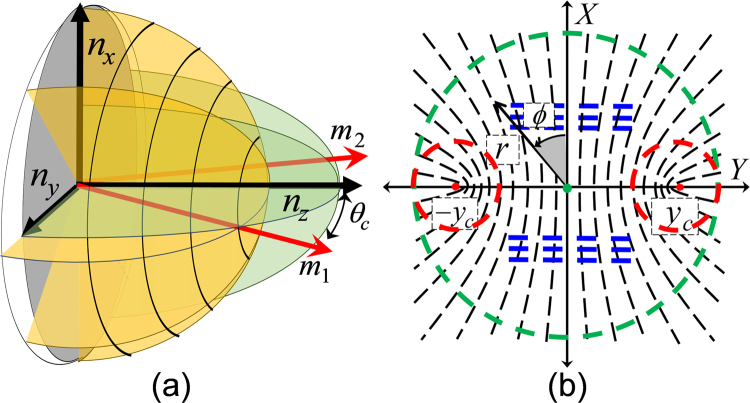
Electric-field applied perpendicular to the direction of propagation of paraxial beam through an optical crystal dynamically modifies the spin-orbit interaction (SOI), leading to the demonstration of controllable spin-Hall effect of light (SHEL). The electro- and piezo-optic effects of the crystal modifies the radially symmetric spatial variation in the fast-axis orientation of the crystal, resulting in a complex pattern with different topologies due to the symmetry-breaking effect of the applied field. This introduces spatially-varying Pancharatnam-Berry type geometric phase on to the paraxial beam of light, leading to the observation of SHEL in addition to the spin-to-vortex conversion. A wave-vector resolved conoscopic Mueller matrix measurement and analysis provides a first glimpse of the SHEL in the biaxial crystal, identified via the appearance of weak circular birefringence. The emergence of field-controllable fast-axis orientation of the crystal and the resulting SHEL provides a new degree of freedom for affecting and controlling the spin and orbital angular momentum of photons to unravel the rich underlying physics of optical crystals and aid in the development of active photonic spin-Hall devices.
§ The Valyu brief
Reading the full paper and taking notes. This takes a few seconds…
§ Ask this paper
Ask a question about this paper
Valyu reads the full text and answers from what the paper actually says.
Searching the other archives…