Recurrence of task-related electroencephalographic activity during post-training quiet rest and sleep
Michael Murphy, Robert Stickgold, Mittie Elaine Parr, Cameron Callahan, Erin J. Wamsley
Abstract
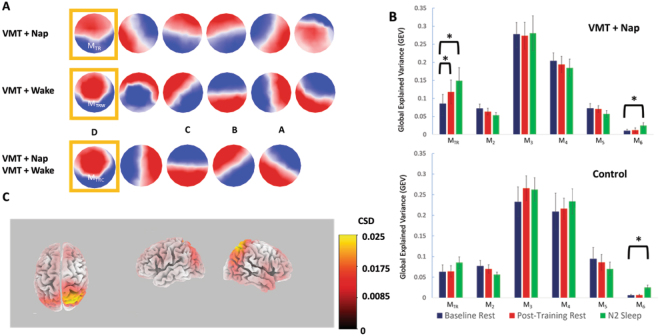
'Cameron Callahan' 'Erin J. Wamsley'] Offline reactivation of task-related neural activity has been demonstrated in animals but is difficult to directly observe in humans. We sought to identify potential electroencephalographic (EEG) markers of offline memory processing in human subjects by identifying a set of characteristic EEG topographies (“microstates”) that occurred as subjects learned to navigate a virtual maze. We hypothesized that these task-related microstates would appear during post-task periods of rest and sleep. In agreement with this hypothesis, we found that one task-related microstate was increased in post-training rest and sleep compared to baseline rest, selectively for subjects who actively learned the maze, and not in subjects performing a non-learning control task. Source modeling showed that this microstate was produced by activity in temporal and parietal networks, which are known to be involved in spatial navigation. For subjects who napped after training, the increase in this task-related microstate predicted the magnitude of subsequent change in performance. Our findings demonstrate that task-related EEG patterns re-emerge during post-training rest and sleep.
§ The Valyu brief
Reading the full paper and taking notes. This takes a few seconds…
§ Ask this paper
Ask a question about this paper
Valyu reads the full text and answers from what the paper actually says.
Searching the other archives…