Assessing the impacts of imperfect detection on estimates of diversity and community structure through multispecies occupancy modeling BENOIT et al.
David Benoit, Donald A. Jackson, Mark S. Ridgway
Abstract
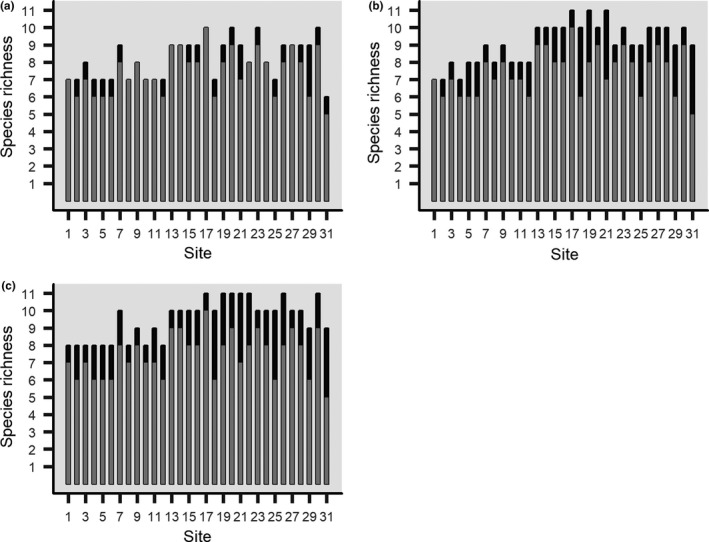
Detecting all species in a given survey is challenging, regardless of sampling effort. This issue, more commonly known as imperfect detection, can have negative impacts on data quality and interpretation, most notably leading to false absences for rare or difficult-to-detect species. It is important that this issue be addressed, as estimates of species richness are critical to many areas of ecological research and management. In this study, we set out to determine the impacts of imperfect detection, and decisions about thresholds for inclusion in occupancy, on estimates of species richness and community structure. We collected data from a stream fish assemblage in Algonquin Provincial Park to be used as a representation of ecological communities. We then used multispecies occupancy modeling to estimate species-specific occurrence probabilities while accounting for imperfect detection, thus creating a more informed dataset. This dataset was then compared to the original to see where differences occurred. In our analyses, we demonstrated that imperfect detection can lead to large changes in estimates of species richness at the site level and summarized differences in the community structure and sampling locations, represented through correspondence analyses.
§ The Valyu brief
Reading the full paper and taking notes. This takes a few seconds…
§ Ask this paper
Ask a question about this paper
Valyu reads the full text and answers from what the paper actually says.
Searching the other archives…