The Relation Between Emotion Understanding and Theory of Mind in Children Aged 3 to 8: The Key Role of Language
Ilaria Grazzani, Veronica Ornaghi, Elisabetta Conte, Alessandro Pepe, Claudia Caprin
Abstract
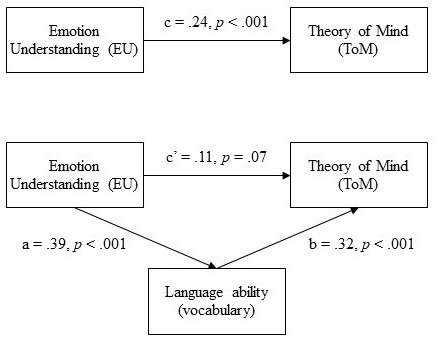
'Claudia Caprin'] Although a significant body of research has investigated the relationships among children’s emotion understanding (EU), theory of mind (ToM), and language abilities. As far as we know, no study to date has been conducted with a sizeable sample of both preschool and school-age children exploring the direct effect of EU on ToM when the role of language was evaluated as a potential exogenous factor in a single comprehensive model. Participants in the current study were 389 children (age range: 37-97 months, M = 60.79 months; SD = 12.66), to whom a False-Belief understanding battery, the Test of Emotion Comprehension, and the Peabody Test were administered. Children’s EU, ToM, and language ability (receptive vocabulary) were positively correlated. Furthermore, EU scores explained variability in ToM scores independently of participants’ age and gender. Finally, language was found to play a crucial role in both explaining variance in ToM scores and in mediating the relationship between EU and ToM. We discuss the theoretical and educational implications of these outcomes, particularly in relation to offering social and emotional learning programs through schools.
§ The Valyu brief
Reading the full paper and taking notes. This takes a few seconds…
§ Ask this paper
Ask a question about this paper
Valyu reads the full text and answers from what the paper actually says.
Searching the other archives…