Flocking propensity by satellites, but not core members of mixed-species flocks, increases when individuals experience energetic deficits in a poor-quality foraging habitat Satellite flocking propensity changes with energetic constraints
Katherine E. Gentry, Daniel P. Roche, Stephen G. Mugel, Nolan D. Lancaster, Kathryn E. Sieving, Todd M. Freeberg, Jeffrey R. Lucas, Almo Farina
Abstract
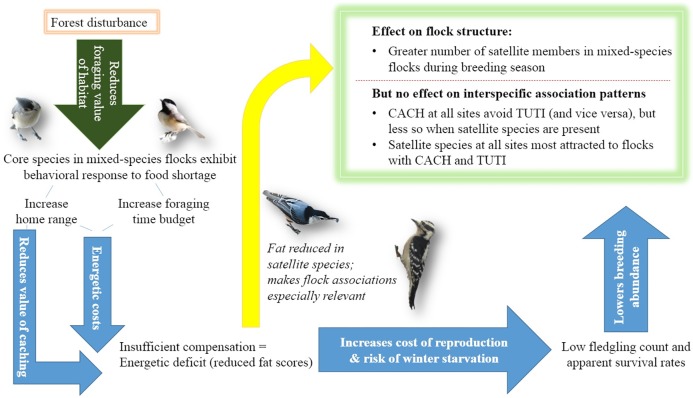
'Nolan D. Lancaster' 'Kathryn E. Sieving' 'Todd M. Freeberg' 'Jeffrey R. Lucas' 'Almo Farina'] Mixed-species bird flocks are complex social systems comprising core and satellite members. Flocking species are sensitive to habitat disturbance, but we are only beginning to understand how species-specific responses to habitat disturbance affect interspecific associations in these flocks. Here we demonstrate the effects of human-induced habitat disturbance on flocking species’ behavior, demography, and individual condition within a remnant network of temperate deciduous forest patches in Indiana, USA. Specifically, we characterized the following properties of two core species, Carolina chickadees (Poecile carolinensis) and tufted titmice (Baeolophus bicolor), across a secondary-forest disturbance gradient: foraging time budgets, home range size, fat scores, fledgling counts, survival rates, and abundance. We also report fat scores for two satellite species that flock with the core study species: white-breasted nuthatches (Sitta carolinensis) and downy woodpeckers (Dryobates pubescens). Finally, we assess mixed-species flock sizes and composition, in addition to avian predator call rates, across the disturbance gradient. Foraging time budgets and home range size were highest and fat scores were lowest for core species in the most-disturbed site. Fat scores of two satellite species followed the same pattern. Additionally, the number of tufted titmice fledglings and winter survival rate of Carolina chickadees were lowest at the most-disturbed site. These results suggest that core species in the most-disturbed site experienced energetic deficits. Moreover, cumulative calling rate of raptors was lowest at the most-disturbed site, and none of the individual raptor species call rates were higher at the most-disturbed site-suggesting that perception of predation risk does not contribute to these patterns. Surprisingly, the satellites continued associating with mixed species flocks through the breeding season at the most-disturbed site. Total flock size and interspecific association patterns were otherwise consistent across the gradient.
§ The Valyu brief
Reading the full paper and taking notes. This takes a few seconds…
§ Ask this paper
Ask a question about this paper
Valyu reads the full text and answers from what the paper actually says.
Searching the other archives…