Vision-Based Robot Navigation through Combining Unsupervised Learning and Hierarchical Reinforcement Learning
Xiaomao Zhou, Tao Bai, Yanbin Gao, Yuntao Han
Abstract
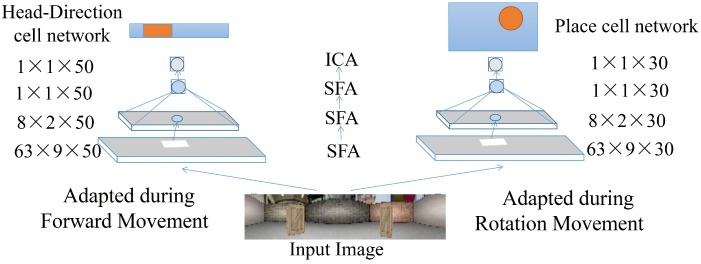
Extensive studies have shown that many animals’ capability of forming spatial representations for self-localization, path planning, and navigation relies on the functionalities of place and head-direction (HD) cells in the hippocampus. Although there are numerous hippocampal modeling approaches, only a few span the wide functionalities ranging from processing raw sensory signals to planning and action generation. This paper presents a vision-based navigation system that involves generating place and HD cells through learning from visual images, building topological maps based on learned cell representations and performing navigation using hierarchical reinforcement learning. First, place and HD cells are trained from sequences of visual stimuli in an unsupervised learning fashion. A modified Slow Feature Analysis (SFA) algorithm is proposed to learn different cell types in an intentional way by restricting their learning to separate phases of the spatial exploration. Then, to extract the encoded metric information from these unsupervised learning representations, a self-organized learning algorithm is adopted to learn over the emerged cell activities and to generate topological maps that reveal the topology of the environment and information about a robot’s head direction, respectively. This enables the robot to perform self-localization and orientation detection based on the generated maps. Finally, goal-directed navigation is performed using reinforcement learning in continuous state spaces which are represented by the population activities of place cells. In particular, considering that the topological map provides a natural hierarchical representation of the environment, hierarchical reinforcement learning (HRL) is used to exploit this hierarchy to accelerate learning. The HRL works on different spatial scales, where a high-level policy learns to select subgoals and a low-level policy learns over primitive actions to specialize on the selected subgoals.
§ The Valyu brief
Reading the full paper and taking notes. This takes a few seconds…
§ Ask this paper
Ask a question about this paper
Valyu reads the full text and answers from what the paper actually says.
Searching the other archives…