The promises and challenges of patient‐derived tumor organoids in drug development and precision oncology GRANAT et al.
Lauren M. Granat, Ooha Kambhampati, Stephanie Klosek, Brian Niedzwecki, Kian Parsa, Dong Zhang
Abstract
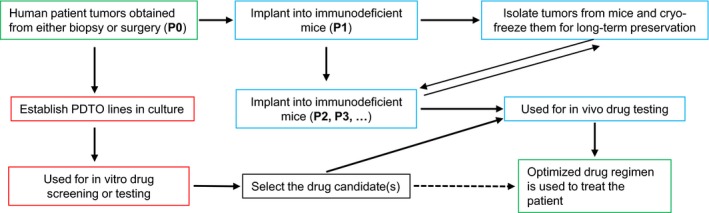
'Brian Niedzwecki' 'Kian Parsa' 'Dong Zhang'] Title: Abstract In the era of precision medicine, cancer researchers and oncologists are eagerly searching for more realistic, cost effective, and timely tumor models to aid drug development and precision oncology. Tumor models that can faithfully recapitulate the histological and molecular characteristics of various human tumors will be extremely valuable in increasing the successful rate of oncology drug development and discovering the most efficacious treatment regimen for cancer patients. Two-dimensional (2D) cultured cancer cell lines, genetically engineered mouse tumor (GEMT) models, and patient-derived tumor xenograft (PDTX) models have been widely used to investigate the biology of various types of cancers and test the efficacy of oncology drug candidates. However, due to either the failure to faithfully recapitulate the complexity of patient tumors in the case of 2D cultured cancer cells, or high cost and untimely for drug screening and testing in the case of GEMT and PDTX, new tumor models are urgently needed. The recently developed patient-derived tumor organoids (PDTO) offer great potentials in uncovering novel biology of cancer development, accelerating the discovery of oncology drugs, and individualizing the treatment of cancers. In this review, we will summarize the recent progress in utilizing PDTO for oncology drug discovery. In addition, we will discuss the potentials and limitations of the current PDTO tumor models.
§ The Valyu brief
Reading the full paper and taking notes. This takes a few seconds…
§ Ask this paper
Ask a question about this paper
Valyu reads the full text and answers from what the paper actually says.
Searching the other archives…