A Definition of “Multitargeticity”: Identifying Potential Multitarget and Selective Ligands Through a Vector Analysis
Juan Francisco Sánchez-Tejeda, Juan F. Sánchez-Ruiz, Juan Rodrigo Salazar, Marco A. Loza-Mejía
Abstract
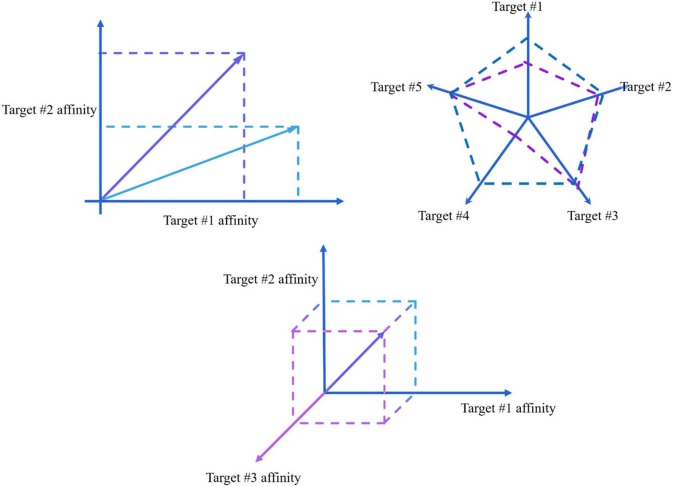
'Juan Rodrigo Salazar' 'Marco A. Loza-Mejía'] The design of multitarget drugs is an essential area of research in Medicinal Chemistry since they have been proposed as potential therapeutics for the management of complex diseases. However, defining a multitarget drug is not an easy task. In this work, we propose a vector analysis for measuring and defining “multitargeticity.” We developed terms, such as order and force of a ligand, to finally reach two parameters: multitarget indexes 1 and 2. The combination of these two indexes allows discrimination of multitarget drugs. Several training sets were constructed to test the usefulness of the indexes: an experimental training set, with real affinities, a docking training set, within theoretical values, and an extensive database training set. The indexes proved to be useful, as they were used independently in silico and experimental data, identifying actual multitarget compounds and even selective ligands in most of the training sets. We then applied these indexes to evaluate a virtual library of potential ligands for targets related to multiple sclerosis, identifying 10 compounds that are likely leads for the development of multitarget drugs based on their in silico behavior. With this work, a new milestone is made in the way of defining multitargeticity and in drug design.
§ The Valyu brief
Reading the full paper and taking notes. This takes a few seconds…
§ Ask this paper
Ask a question about this paper
Valyu reads the full text and answers from what the paper actually says.
Searching the other archives…