German Aerospace Center's advanced robotic technology for future lunar scientific missions DLR's Advanced Robotic Technology
Armin Wedler, Martin J. Schuster, Marcus G. Müller, Bernhard Vodermayer, Lukas Meyer, Riccardo Giubilato, Mallikarjuna Vayugundla, Michal Smisek, Andreas Dömel, Florian Steidle, Peter Lehner, Susanne Schröder, Emanuel Staudinger, Bernard Foing, Josef Reill
Abstract
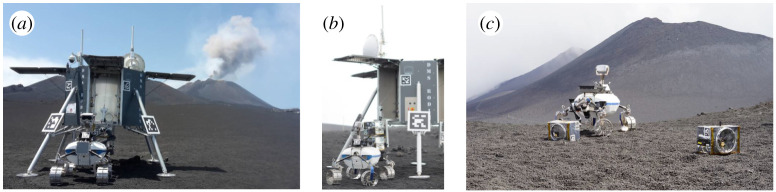
'Bernhard Vodermayer' 'Lukas Meyer' 'Riccardo Giubilato' 'Mallikarjuna Vayugundla' 'Michal Smisek' 'Andreas Dömel' 'Florian Steidle' 'Peter Lehner' 'Susanne Schröder' 'Emanuel Staudinger' 'Bernard Foing' 'Josef Reill'] The Earth's moon is currently an object of interest of many space agencies for unmanned robotic missions within this decade. Besides future prospects for building lunar gateways as support to human space flight, the Moon is an attractive location for scientific purposes. Not only will its study give insight on the foundations of the Solar System but also its location, uncontaminated by the Earth's ionosphere, represents a vantage point for the observation of the Sun and planetary bodies outside the Solar System. Lunar exploration has been traditionally conducted by means of single-agent robotic assets, which is a limiting factor for the return of scientific missions. The German Aerospace Center (DLR) is developing fundamental technologies towards increased autonomy of robotic explorers to fulfil more complex mission tasks through cooperation. This paper presents an overview of past, present and future activities of DLR towards highly autonomous systems for scientific missions targeting the Moon and other planetary bodies. The heritage from the Mobile Asteroid Scout (MASCOT), developed jointly by DLR and CNES and deployed on asteroid Ryugu on 3 October 2018 from JAXA's Hayabusa2 spacecraft, inspired the development of novel core technologies towards higher efficiency in planetary exploration. Together with the lessons learnt from the ROBEX project (2012-2017), where a mobile robot autonomously deployed seismic sensors at a Moon analogue site, this experience is shaping the future steps towards more complex space missions. They include the development of a mobile rover for JAXA's Martian Moons eXploration (MMX) in 2024 as well as demonstrations of novel multi-robot technologies at a Moon analogue site on the volcano Mt Etna in the ARCHES project.
§ The Valyu brief
Reading the full paper and taking notes. This takes a few seconds…
§ Ask this paper
Ask a question about this paper
Valyu reads the full text and answers from what the paper actually says.
Searching the other archives…