RF-Powered Low-Energy Sensor Nodes for Predictive Maintenance in Electromagnetically Harsh Industrial Environments
Giacomo Paolini, Marco Guermandi, Diego Masotti, Mazen Shanawani, Francesca Benassi, Luca Benini, Alessandra Costanzo
Abstract
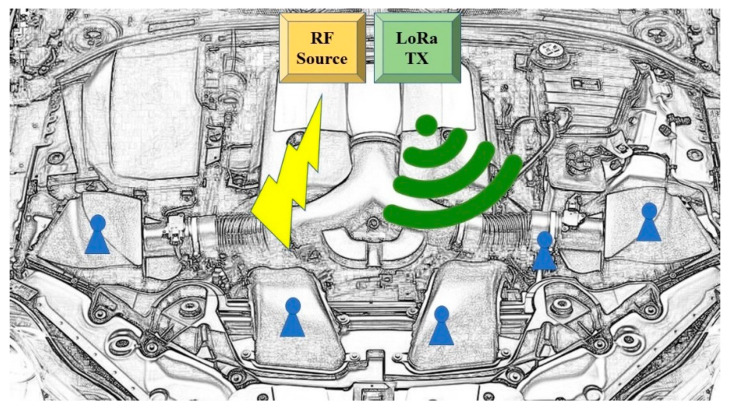
'Francesca Benassi' 'Luca Benini' 'Alessandra Costanzo'] This work describes the design, implementation, and validation of a wireless sensor network for predictive maintenance and remote monitoring in metal-rich, electromagnetically harsh environments. Energy is provided wirelessly at 2.45 GHz employing a system of three co-located active antennas designed with a conformal shape such that it can power, on-demand, sensor nodes located in non-line-of-sight (NLOS) and difficult-to-reach positions. This allows for eliminating the periodic battery replacement of the customized sensor nodes, which are designed to be compact, low-power, and robust. A measurement campaign has been conducted in a real scenario, i.e., the engine compartment of a car, assuming the exploitation of the system in the automotive field. Our work demonstrates that a one radio-frequency (RF) source (illuminator) with a maximum effective isotropic radiated power (EIRP) of 27 dBm is capable of transferring the energy of 4.8 mJ required to fully charge the sensor node in less than 170 s, in the worst case of 112-cm distance between illuminator and node (NLOS). We also show how, in the worst case, the transferred power allows the node to operate every 60 s, where operation includes sampling accelerometer data for 1 s, extracting statistical information, transmitting a 20-byte payload, and receiving a 3-byte acknowledgment using the extremely robust Long Range (LoRa) communication technology. The energy requirement for an active cycle is between 1.45 and 1.65 mJ, while sleep mode current consumption is less than 150 nA, allowing for achieving the targeted battery-free operation with duty cycles as high as 1.7%.
§ The Valyu brief
Reading the full paper and taking notes. This takes a few seconds…
§ Ask this paper
Ask a question about this paper
Valyu reads the full text and answers from what the paper actually says.
Searching the other archives…