Learning temporal attention in dynamic graphs with bilinear interactions Attention-based dynamic graph learning
Boris Knyazev, Carolyn Augusta, Graham W. Taylor, Chi Ho Yeung
Abstract
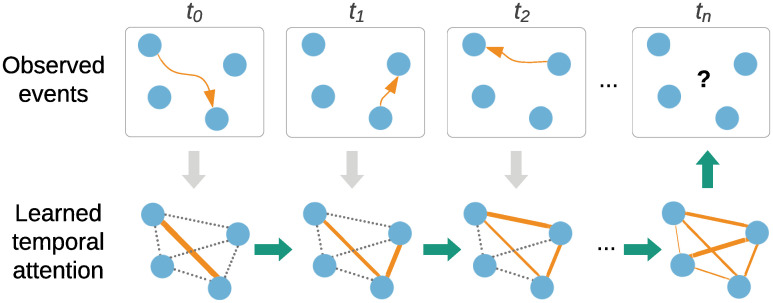
Reasoning about graphs evolving over time is a challenging concept in many domains, such as bioinformatics, physics, and social networks. We consider a common case in which edges can be short term interactions (e.g., messaging) or long term structural connections (e.g., friendship). In practice, long term edges are often specified by humans. Human-specified edges can be both expensive to produce and suboptimal for the downstream task. To alleviate these issues, we propose a model based on temporal point processes and variational autoencoders that learns to infer temporal attention between nodes by observing node communication. As temporal attention drives between-node feature propagation, using the dynamics of node interactions to learn this key component provides more flexibility while simultaneously avoiding issues associated with human-specified edges. We also propose a bilinear transformation layer for pairs of node features instead of concatenation, typically used in prior work, and demonstrate its superior performance in all cases. In experiments on two datasets in the dynamic link prediction task, our model often outperforms the baseline model that requires a human-specified graph. Moreover, our learned attention is semantically interpretable and infers connections similar to actual graphs.
§ The Valyu brief
Reading the full paper and taking notes. This takes a few seconds…
§ Ask this paper
Ask a question about this paper
Valyu reads the full text and answers from what the paper actually says.
Searching the other archives…