Bayesian ridge regression shows the best fit for SSR markers in <i> Psidium guajava </i> among Bayesian models
Flavia Alves da Silva, Alexandre Pio Viana, Caio Cezar Guedes Correa, Eileen Azevedo Santos, Julie Anne Vieira Salgado de Oliveira, José Daniel Gomes Andrade, Rodrigo Moreira Ribeiro, Leonardo Siqueira Glória
Abstract
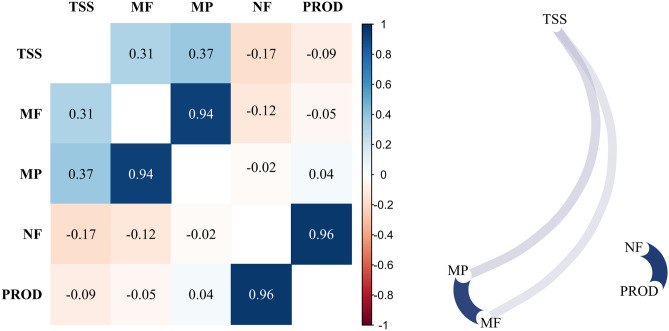
'Eileen Azevedo Santos' 'Julie Anne Vieira Salgado de Oliveira' 'José Daniel Gomes Andrade' 'Rodrigo Moreira Ribeiro' 'Leonardo Siqueira Glória'] Markers are an important tool in plant breeding, which can improve conventional phenotypic breeding, generating more accurate information outcoming better decision making. This study aimed to apply and compare the fit of different Bayesian models BRR, BayesA, BayesB, BayesB (setting the value from very low to $\pi$ = ${10}^{-5}$), BayesC and Bayesian Lasso (LASSO) for predictions of the genomic genetic values of productivity and quality traits of a guava population. The models were fitted for traits fruit mass, pulp mass, soluble solids content, fruit number, and production per plant in the genomic prediction with SSR markers, obtained through the CTAB extraction method with 200 primers. The Bayesian ridge regression model showed the best results for all traits and was chosen to predict the individual’s genomic values according to the cross-validation data. A good stabilization of the Markov and Monte Carlo chains was observed with the mean values close to the observed phenotypic means. Heritabilities showed good predictive accuracy. The model showed strong correlations between some traits, allowing indirect selection.
§ The Valyu brief
Reading the full paper and taking notes. This takes a few seconds…
§ Ask this paper
Ask a question about this paper
Valyu reads the full text and answers from what the paper actually says.
Searching the other archives…