Unsupervised changes in core object recognition behavior are predicted by neural plasticity in inferior temporal cortex
Xiaoxuan Jia, Ha Hong, James J DiCarlo, Michael J Frank, Thomas Serre
Abstract
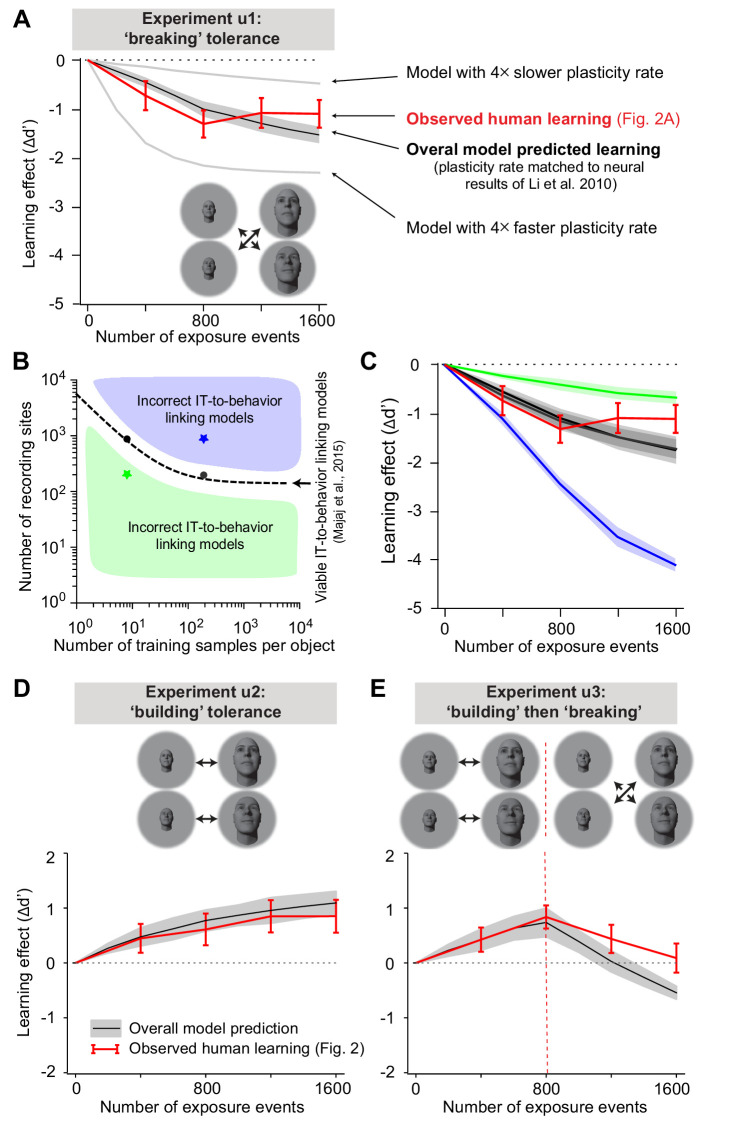
Temporal continuity of object identity is a feature of natural visual input and is potentially exploited - in an unsupervised manner - by the ventral visual stream to build the neural representation in inferior temporal (IT) cortex. Here, we investigated whether plasticity of individual IT neurons underlies human core object recognition behavioral changes induced with unsupervised visual experience. We built a single-neuron plasticity model combined with a previously established IT population-to-recognition-behavior-linking model to predict human learning effects. We found that our model, after constrained by neurophysiological data, largely predicted the mean direction, magnitude, and time course of human performance changes. We also found a previously unreported dependency of the observed human performance change on the initial task difficulty. This result adds support to the hypothesis that tolerant core object recognition in human and non-human primates is instructed - at least in part - by naturally occurring unsupervised temporal contiguity experience.
§ The Valyu brief
Reading the full paper and taking notes. This takes a few seconds…
§ Ask this paper
Ask a question about this paper
Valyu reads the full text and answers from what the paper actually says.
Searching the other archives…