The Reciprocal Longitudinal Relationship between Executive Dysfunction and Happiness in Korean Children
Yoonhee Sung, Eunsil Choi, Andrea Chirico, Pierluigi Diotaiuti, Elisa Cavicchiolo
Abstract
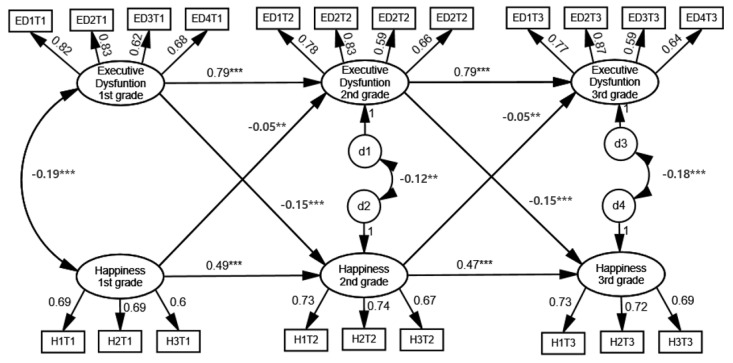
'Elisa Cavicchiolo'] The goal of this study was to examine the reciprocal longitudinal relationships between executive dysfunction and happiness for Korean children. We used data from the Panel Study of Korean Children (PSKC) conducted by the Korean Institute of Child Care and Education. A total of 1240 valid responses from the first to third grade in elementary school were analyzed using autoregressive crossed-lagged modeling. As a result, executive dysfunction and happiness were found to have reciprocal influences over the three time points. We also found that the cross-lagged effects of executive dysfunction and happiness were stronger than those of happiness on executive dysfunction. Clinical implications and limitations were discussed.
§ The Valyu brief
Reading the full paper and taking notes. This takes a few seconds…
§ Ask this paper
Ask a question about this paper
Valyu reads the full text and answers from what the paper actually says.
Searching the other archives…