Insights into substrate recognition and specificity for IgG by Endoglycosidase S2 Molecular modeling and dynamics simulations of Endoglycosidase S2-Fc complexes
Asaminew H. Aytenfisu, Daniel Deredge, Erik H. Klontz, Jonathan Du, Eric J. Sundberg, Alexander D. MacKerell Jr, David van der Spoel
Abstract
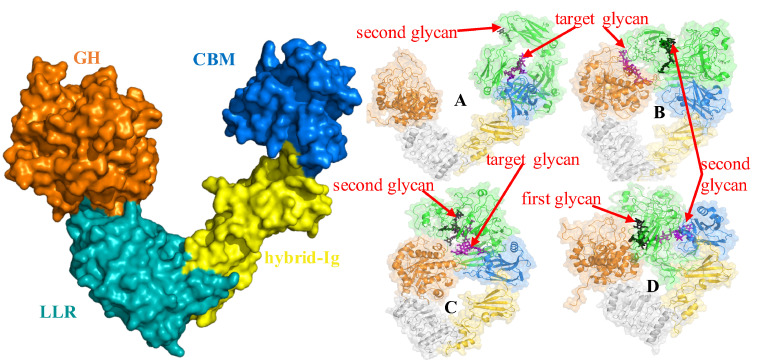
'Eric J. Sundberg' 'Alexander D. MacKerell Jr' 'David van der Spoel'] Antibodies bind foreign antigens with high affinity and specificity leading to their neutralization and/or clearance by the immune system. The conserved N-glycan on IgG has significant impact on antibody effector function, with the endoglycosidases of Streptococcus pyogenes deglycosylating the IgG to evade the immune system, a process catalyzed by the endoglycosidase EndoS2. Studies have shown that two of the four domains of EndoS2, the carbohydrate binding module (CBM) and the glycoside hydrolase (GH) domain are critical for catalytic activity. To yield structural insights into contributions of the CBM and the GH domains as well as the overall flexibility of EndoS2 to the proteins’ catalytic activity, models of EndoS2-Fc complexes were generated through enhanced-sampling molecular-dynamics (MD) simulations and site-identification by ligand competitive saturation (SILCS) docking followed by reconstruction and multi-microsecond MD simulations. Modeling results predict that EndoS2 initially interacts with the IgG through its CBM followed by interactions with the GH yielding catalytically competent states. These may involve the CBM and GH of EndoS2 simultaneously interacting with either the same Fc CH2/CH3 domain or individually with the two Fc CH2/CH3 domains, with EndoS2 predicted to assume closed conformations in the former case and open conformations in the latter. Apo EndoS2 is predicted to sample both the open and closed states, suggesting that either complex can directly form following initial IgG-EndoS2 encounter. Interactions of the CBM and GH domains with the IgG are predicted to occur through both its glycan and protein regions. Simulations also predict that the Fc glycan can directly transfer from the CBM to the GH, facilitating formation of catalytically competent complexes and how the 734 to 751 loop on the CBM can facilitate extraction of the glycan away from the Fc CH2/CH3 domain. The predicted models are compared and consistent with Hydrogen/Deuterium Exchange data.
§ The Valyu brief
Reading the full paper and taking notes. This takes a few seconds…
§ Ask this paper
Ask a question about this paper
Valyu reads the full text and answers from what the paper actually says.
Searching the other archives…