Peering into the dark (ages) with low-frequency space interferometers Using the 21-cm signal of neutral hydrogen from the infant universe to probe fundamental (Astro)physics
Léon V. E. Koopmans, Rennan Barkana, Mark Bentum, Gianni Bernardi, Albert-Jan Boonstra, Judd Bowman, Jack Burns, Xuelei Chen, Abhirup Datta, Heino Falcke, Anastasia Fialkov, Bharat Gehlot, Leonid Gurvits, Vibor Jelić, Marc Klein-Wolt, Joseph Lazio, Daan Meerburg, Garrelt Mellema, Florent Mertens, Andrei Mesinger, André Offringa, Jonathan Pritchard, Benoit Semelin, Ravi Subrahmanyan, Joseph Silk, Cathryn Trott, Harish Vedantham, Licia Verde, Saleem Zaroubi, Philippe Zarka
Abstract
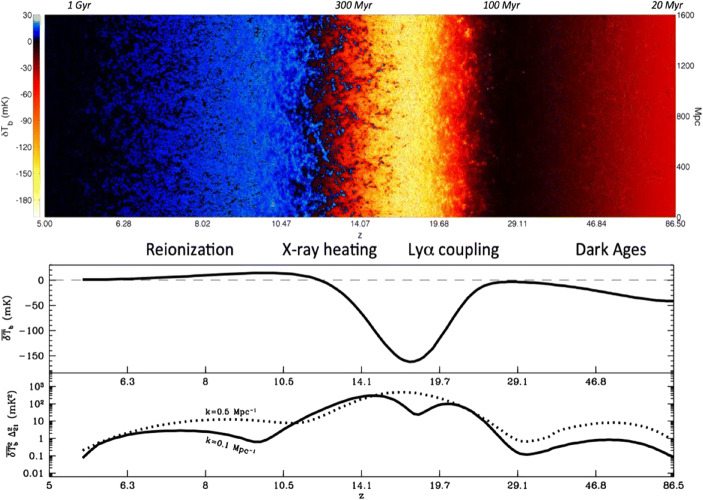
The Dark Ages and Cosmic Dawn are largely unexplored windows on the infant Universe (z ~ 200-10). Observations of the redshifted 21-cm line of neutral hydrogen can provide valuable new insight into fundamental physics and astrophysics during these eras that no other probe can provide, and drives the design of many future ground-based instruments such as the Square Kilometre Array (SKA) and the Hydrogen Epoch of Reionization Array (HERA). We review progress in the field of high-redshift 21-cm Cosmology, in particular focussing on what questions can be addressed by probing the Dark Ages at z > 30. We conclude that only a space- or lunar-based radio telescope, shielded from the Earth’s radio-frequency interference (RFI) signals and its ionosphere, enable the 21-cm signal from the Dark Ages to be detected. We suggest a generic mission design concept, CoDEX, that will enable this in the coming decades.
§ The Valyu brief
Reading the full paper and taking notes. This takes a few seconds…
§ Ask this paper
Ask a question about this paper
Valyu reads the full text and answers from what the paper actually says.
Searching the other archives…