Structured time-delay models for dynamical systems with connections to Frenet–Serret frame Structured time-delay models for dynamical systems with connections to Frenet–Serret Frame
Seth M. Hirsh, Sara M. Ichinaga, Steven L. Brunton, J. Nathan Kutz, Bingni W. Brunton
Abstract
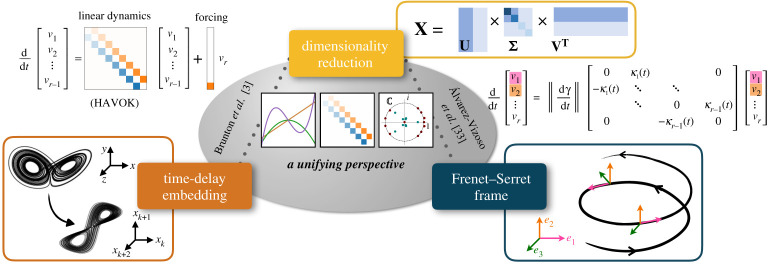
Time-delay embedding and dimensionality reduction are powerful techniques for discovering effective coordinate systems to represent the dynamics of physical systems. Recently, it has been shown that models identified by dynamic mode decomposition on time-delay coordinates provide linear representations of strongly nonlinear systems, in the so-called Hankel alternative view of Koopman (HAVOK) approach. Curiously, the resulting linear model has a matrix representation that is approximately antisymmetric and tridiagonal; for chaotic systems, there is an additional forcing term in the last component. In this paper, we establish a new theoretical connection between HAVOK and the Frenet-Serret frame from differential geometry, and also develop an improved algorithm to identify more stable and accurate models from less data. In particular, we show that the sub- and super-diagonal entries of the linear model correspond to the intrinsic curvatures in the Frenet-Serret frame. Based on this connection, we modify the algorithm to promote this antisymmetric structure, even in the noisy, low-data limit. We demonstrate this improved modelling procedure on data from several nonlinear synthetic and real-world examples.
§ The Valyu brief
Reading the full paper and taking notes. This takes a few seconds…
§ Ask this paper
Ask a question about this paper
Valyu reads the full text and answers from what the paper actually says.
Searching the other archives…