Speechreading Ability Is Related to Phonological Awareness and Single-Word Reading in Both Deaf and Hearing Children
Elizabeth Buchanan-Worster, Mairéad MacSweeney, Hannah Pimperton, Fiona Kyle, Margaret Harris, Indie Beedie, Amelia Ralph-Lewis, Charles Hulme
Abstract
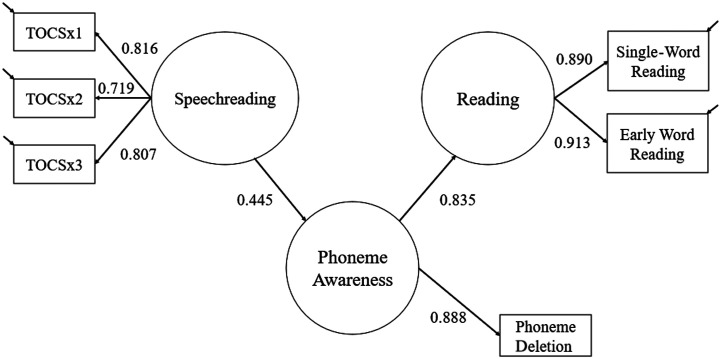
'Fiona Kyle' 'Margaret Harris' 'Indie Beedie' 'Amelia Ralph-Lewis' 'Charles Hulme'] Purpose Speechreading (lipreading) is a correlate of reading ability in both deaf and hearing children. We investigated whether the relationship between speechreading and single-word reading is mediated by phonological awareness in deaf and hearing children. Method In two separate studies, 66 deaf children and 138 hearing children, aged 5-8 years old, were assessed on measures of speechreading, phonological awareness, and single-word reading. We assessed the concurrent relationships between latent variables measuring speechreading, phonological awareness, and single-word reading. Results In both deaf and hearing children, there was a strong relationship between speechreading and single-word reading, which was fully mediated by phonological awareness. Conclusions These results are consistent with ideas from previous studies that visual speech information contributes to the development of phonological representations in both deaf and hearing children, which, in turn, support learning to read. Future longitudinal and training studies are required to establish whether these relationships reflect causal effects.
§ The Valyu brief
Reading the full paper and taking notes. This takes a few seconds…
§ Ask this paper
Ask a question about this paper
Valyu reads the full text and answers from what the paper actually says.
Searching the other archives…