Modular assembly of dynamic models in systems biology Modular assembly of dynamic models in systems biology
Michael Pan, Peter J. Gawthrop, Joseph Cursons, Edmund J. Crampin, Anders Wallqvist
Abstract
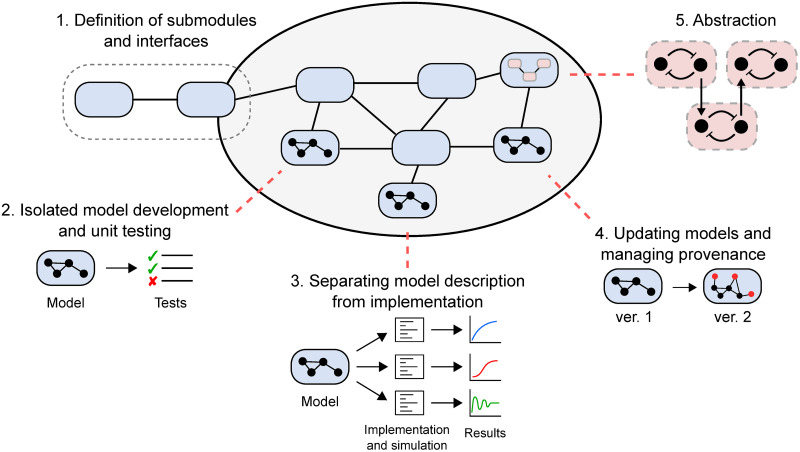
'Anders Wallqvist'] It is widely acknowledged that the construction of large-scale dynamic models in systems biology requires complex modelling problems to be broken up into more manageable pieces. To this end, both modelling and software frameworks are required to enable modular modelling. While there has been consistent progress in the development of software tools to enhance model reusability, there has been a relative lack of consideration for how underlying biophysical principles can be applied to this space. Bond graphs combine the aspects of both modularity and physics-based modelling. In this paper, we argue that bond graphs are compatible with recent developments in modularity and abstraction in systems biology, and are thus a desirable framework for constructing large-scale models. We use two examples to illustrate the utility of bond graphs in this context: a model of a mitogen-activated protein kinase (MAPK) cascade to illustrate the reusability of modules and a model of glycolysis to illustrate the ability to modify the model granularity.
§ The Valyu brief
Reading the full paper and taking notes. This takes a few seconds…
§ Ask this paper
Ask a question about this paper
Valyu reads the full text and answers from what the paper actually says.
Searching the other archives…