Novel Liver Stiffness-Based Nomogram for Predicting Hepatocellular Carcinoma Risk in Patients with Chronic Hepatitis B Virus Infection Initiating Antiviral Therapy
Jae Seung Lee, Hyun Woong Lee, Tae Seop Lim, Hye Jung Shin, Hye Won Lee, Seung Up Kim, Jun Yong Park, Do Young Kim, Sang Hoon Ahn, Beom Kyung Kim, Liliana Chemello, Yoshihiro Kamada
Abstract
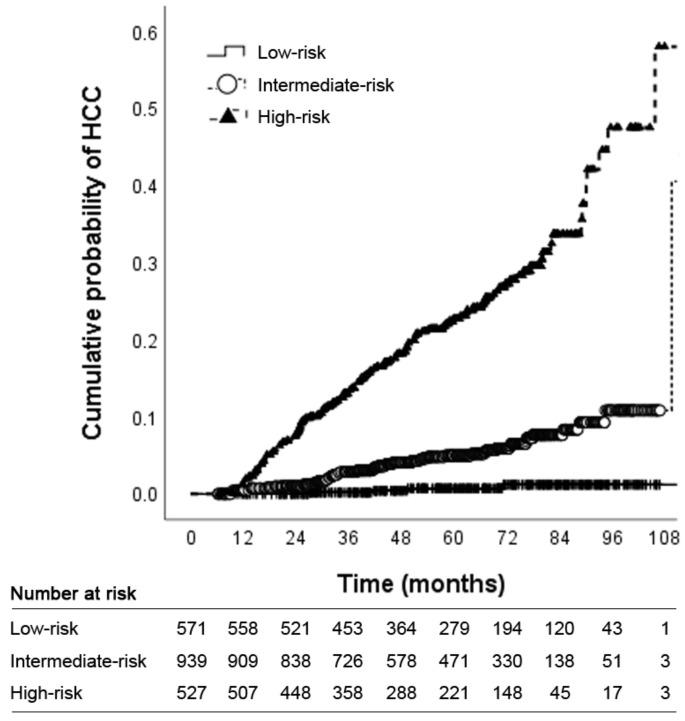
Simple Summary We developed a novel risk-scoring model for hepatocellular carcinoma development in treatment-naïve patients with chronic hepatitis B virus infection who are starting antiviral therapy with entecavir or tenofovir. The model reflects age, platelet count, hepatitis B e antigen positivity, serum albumin and total bilirubin levels, cirrhosis development, and liver stiffness values measured by transient elastography. Our new model showed better performance for predicting hepatocellular carcinoma development (Harrell’s c-index: 0.799) than the PAGE-B, modified PAGE-B, and modified REACH-B models in Asian patients with chronic hepatitis B receiving potent antiviral therapy. Abstract Hepatocellular carcinoma (HCC) risk prediction is important to developing individualized surveillance approaches. We designed a novel HCC prediction model using liver stiffness on transient elastography for patients receiving antiviral therapy against hepatitis B virus (HBV) infection. We recruited 2037 patients receiving entecavir or tenofovir as first-line antivirals and used the Cox regression analysis to determine key variables for model construction. Within 58.1 months (median), HCC developed in 182 (8.9%) patients. Patients with HCC showed a higher prevalence of cirrhosis (90.7% vs. 45.9%) and higher liver stiffness values (median 13.9 vs. 7.2 kPa) than those without. A novel nomogram (score 0-304) was established using age, platelet count, cirrhosis development, and liver stiffness values, which were independently associated with increased HCC risk, along with hepatitis B e antigen positivity and serum albumin and total bilirubin levels. Cumulative HCC probabilities were 0.7%, 5.0%, and 22.7% in the low- (score ≤87), intermediate- (88-222), and high-risk (≥223) groups, respectively. The c-index value was 0.799 (internal validity: 0.805), higher than that of the PAGE-B (0.726), modified PAGE-B (0.756), and modified REACH-B (0.761) models (all p < 0.05). Our nomogram showed acceptable performance in predicting HCC in Asian HBV-infected patients receiving potent antiviral therapy.
§ The Valyu brief
Reading the full paper and taking notes. This takes a few seconds…
§ Ask this paper
Ask a question about this paper
Valyu reads the full text and answers from what the paper actually says.
Searching the other archives…