Eye-tracking as a proxy for coherence and complexity of texts Eye-tracking as a proxy for coherence and complexity of texts
Débora Torres, Wagner R. Sena, Humberto A. Carmona, André A. Moreira, Hernán A. Makse, José S. Andrade Jr., Haroldo V. Ribeiro
Abstract
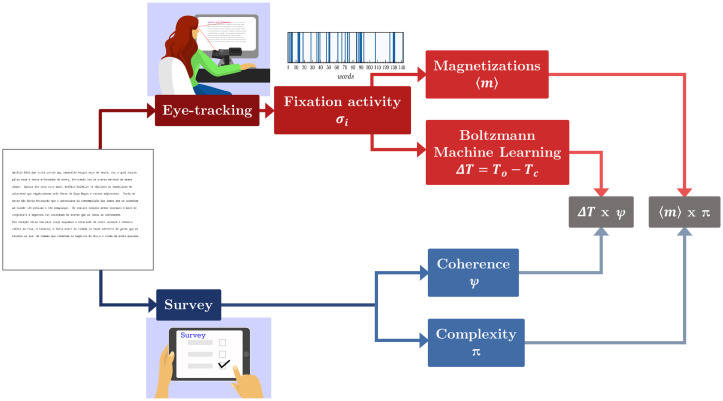
Reading is a complex cognitive process that involves primary oculomotor function and high-level activities like attention focus and language processing. When we read, our eyes move by primary physiological functions while responding to language-processing demands. In fact, the eyes perform discontinuous twofold movements, namely, successive long jumps (saccades) interposed by small steps (fixations) in which the gaze “scans” confined locations. It is only through the fixations that information is effectively captured for brain processing. Since individuals can express similar as well as entirely different opinions about a given text, it is therefore expected that the form, content and style of a text could induce different eye-movement patterns among people. A question that naturally arises is whether these individuals’ behaviours are correlated, so that eye-tracking while reading can be used as a proxy for text subjective properties. Here we perform a set of eye-tracking experiments with a group of individuals reading different types of texts, including children stories, random word generated texts and excerpts from literature work. In parallel, an extensive Internet survey was conducted for categorizing these texts in terms of their complexity and coherence, considering a large number of individuals selected according to different ages, gender and levels of education. The computational analysis of the fixation maps obtained from the gaze trajectories of the subjects for a given text reveals that the average “magnetization” of the fixation configurations correlates strongly with their complexity observed in the survey. Moreover, we perform a thermodynamic analysis using the Maximum-Entropy Model and find that coherent texts were closer to their corresponding “critical points” than non-coherent ones, as computed from the Pairwise Maximum-Entropy method, suggesting that different texts may induce distinct cohesive reading activities.
§ The Valyu brief
Reading the full paper and taking notes. This takes a few seconds…
§ Ask this paper
Ask a question about this paper
Valyu reads the full text and answers from what the paper actually says.
Searching the other archives…