CRISPR-Cas-Led Revolution in Diagnosis and Management of Emerging Plant Viruses: New Avenues Toward Food and Nutritional Security
Susheel Kumar Sharma, Om Prakash Gupta, Neeta Pathaw, Devender Sharma, Albert Maibam, Parul Sharma, Jyotsana Sanasam, Suhas Gorakh Karkute, Sandeep Kumar, Bijoya Bhattacharjee
Abstract
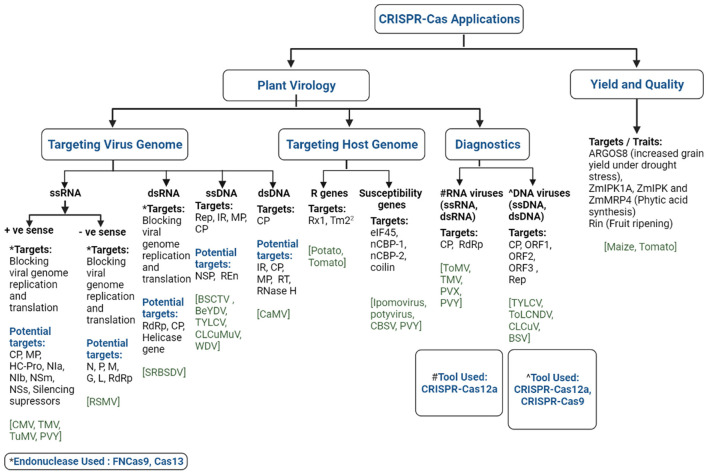
'Devender Sharma' 'Albert Maibam' 'Parul Sharma' 'Jyotsana Sanasam' 'Suhas Gorakh Karkute' 'Sandeep Kumar' 'Bijoya Bhattacharjee'] Plant viruses pose a serious threat to agricultural production systems worldwide. The world's population is expected to reach the 10-billion mark by 2057. Under the scenario of declining cultivable land and challenges posed by rapidly emerging and re-emerging plant pathogens, conventional strategies could not accomplish the target of keeping pace with increasing global food demand. Gene-editing techniques have recently come up as promising options to enable precise changes in genomes with greater efficiency to achieve the target of higher crop productivity. Of genome engineering tools, clustered regularly interspaced short palindromic repeats (CRISPR)/CRISPR-associated (Cas) proteins have gained much popularity, owing to their simplicity, reproducibility, and applicability in a wide range of species. Also, the application of different Cas proteins, such as Cas12a, Cas13a, and Cas9 nucleases, has enabled the development of more robust strategies for the engineering of antiviral mechanisms in many plant species. Recent studies have revealed the use of various CRISPR-Cas systems to either directly target a viral gene or modify a host genome to develop viral resistance in plants. This review provides a comprehensive record of the use of the CRISPR-Cas system in the development of antiviral resistance in plants and discusses its applications in the overall enhancement of productivity and nutritional landscape of cultivated plant species. Furthermore, the utility of this technique for the detection of various plant viruses could enable affordable and precise in-field or on-site detection. The futuristic potential of CRISPR-Cas technologies and possible challenges with their use and application are highlighted. Finally, the future of CRISPR-Cas in sustainable management of viral diseases, and its practical utility and regulatory guidelines in different parts of the globe are discussed systematically.
§ The Valyu brief
Reading the full paper and taking notes. This takes a few seconds…
§ Ask this paper
Ask a question about this paper
Valyu reads the full text and answers from what the paper actually says.
Searching the other archives…