Latent variable and clustering methods in intersectionality research: systematic review of methods applications
Greta R. Bauer, Mayuri Mahendran, Chantel Walwyn, Mostafa Shokoohi
Abstract
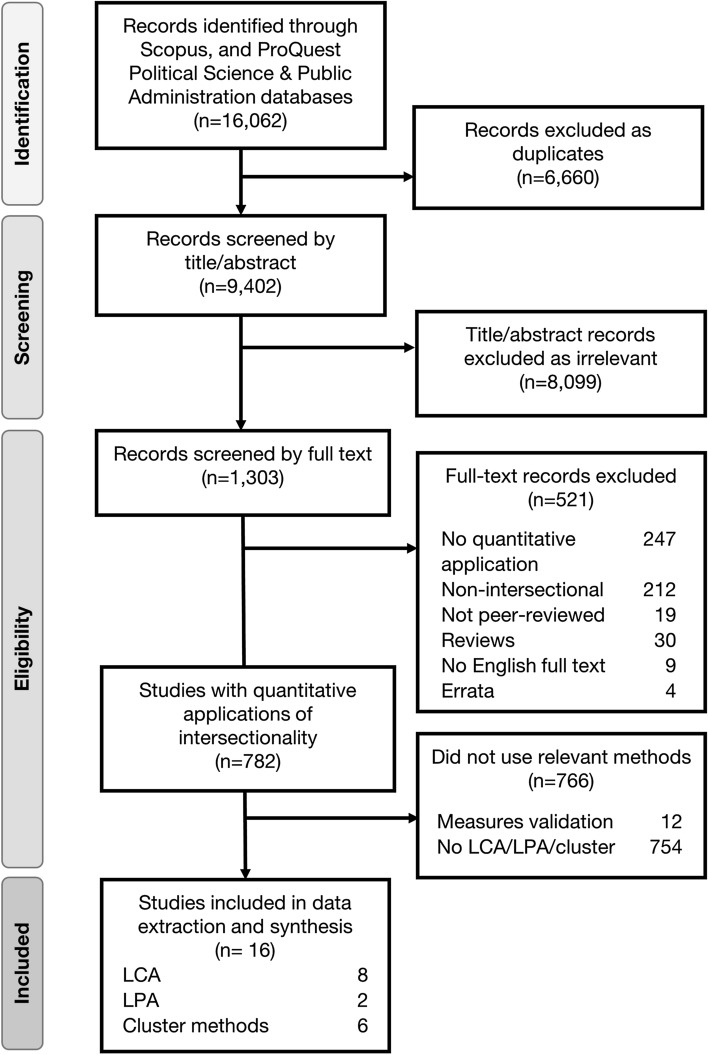
Purpose An intersectionality framework has been increasingly incorporated into quantitative study of health inequity, to incorporate social power in meaningful ways. Researchers have identified “person-centered” methods that cluster within-individual characteristics as appropriate to intersectionality. We aimed to review their use and match with theory. Methods We conducted a multidisciplinary systematic review of English-language quantitative studies wherein authors explicitly stated an intersectional approach, and used clustering methods. We extracted study characteristics and applications of intersectionality. Results 782 studies with quantitative applications of intersectionality were identified, of which 16 were eligible: eight using latent class analysis, two latent profile analysis, and six clustering methods. Papers used cross-sectional data (100.0%) primarily had U.S. lead authors (68.8%) and were published within psychology, social sciences, and health journals. While 87.5% of papers defined intersectionality and 93.8% cited foundational authors, engagement with intersectionality method literature was more limited. Clustering variables were based on social identities/positions (e.g., gender), dimensions of identity (e.g., race centrality), or processes (e.g., stigma). Results most commonly included four classes/clusters (60.0%), which were frequently used in additional analyses. These described sociodemographic differences across classes/clusters, or used classes/clusters as an exposure variable to predict outcomes in regression analysis, structural equation modeling, mediation, or survival analysis. Author rationales for method choice included both theoretical/intersectional and statistical arguments. Conclusion Latent variable and clustering methods were used in varied ways in intersectional approaches, and reflected differing matches between theory and methods. We highlight situations in which these methods may be advantageous, and missed opportunities for additional uses.
§ The Valyu brief
Reading the full paper and taking notes. This takes a few seconds…
§ Ask this paper
Ask a question about this paper
Valyu reads the full text and answers from what the paper actually says.
Searching the other archives…