Comprehensive Genomic Discovery of Non-Coding Transcriptional Enhancers in the African Malaria Vector <i> Anopheles coluzzii </i> Holm et al. <i> Anopheles </i> Transcriptional Enhancer Map
Inge Holm, Luisa Nardini, Adrien Pain, Emmanuel Bischoff, Cameron E. Anderson, Soumanaba Zongo, Wamdaogo M. Guelbeogo, N’Fale Sagnon, Daryl M. Gohl, Ronald J. Nowling, Kenneth D. Vernick, Michelle M. Riehle
Abstract
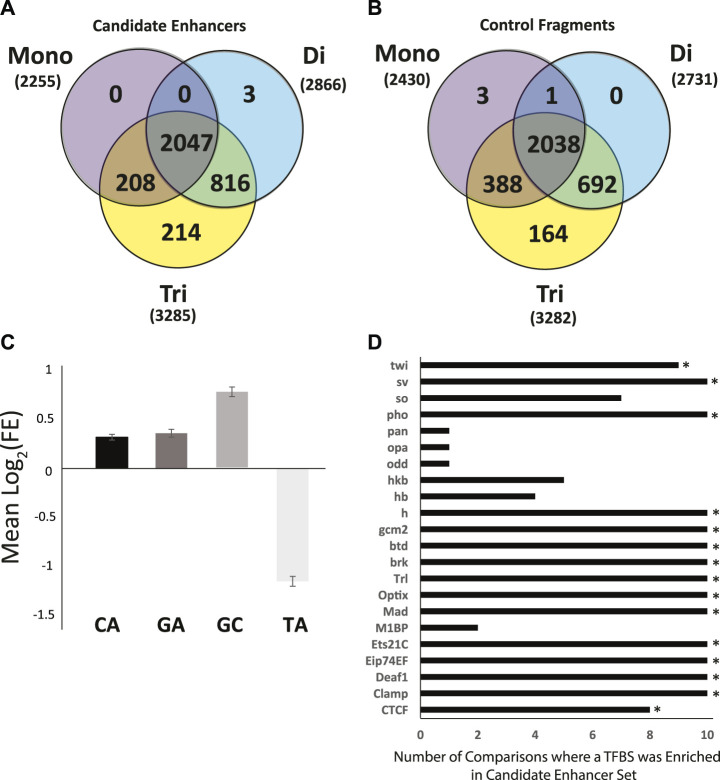
'Cameron E. Anderson' 'Soumanaba Zongo' 'Wamdaogo M. Guelbeogo' 'N’Fale Sagnon' 'Daryl M. Gohl' 'Ronald J. Nowling' 'Kenneth D. Vernick' 'Michelle M. Riehle'] Almost all regulation of gene expression in eukaryotic genomes is mediated by the action of distant non-coding transcriptional enhancers upon proximal gene promoters. Enhancer locations cannot be accurately predicted bioinformatically because of the absence of a defined sequence code, and thus functional assays are required for their direct detection. Here we used a massively parallel reporter assay, Self-Transcribing Active Regulatory Region sequencing (STARR-seq), to generate the first comprehensive genome-wide map of enhancers in Anopheles coluzzii, a major African malaria vector in the Gambiae species complex. The screen was carried out by transfecting reporter libraries created from the genomic DNA of 60 wild A. coluzzii from Burkina Faso into A. coluzzii 4a3A cells, in order to functionally query enhancer activity of the natural population within the homologous cellular context. We report a catalog of 3,288 active genomic enhancers that were significant across three biological replicates, 74% of them located in intergenic and intronic regions. The STARR-seq enhancer screen is chromatin-free and thus detects inherent activity of a comprehensive catalog of enhancers that may be restricted in vivo to specific cell types or developmental stages. Testing of a validation panel of enhancer candidates using manual luciferase assays confirmed enhancer function in 26 of 28 (93%) of the candidates over a wide dynamic range of activity from two to at least 16-fold activity above baseline. The enhancers occupy only 0.7% of the genome, and display distinct composition features. The enhancer compartment is significantly enriched for 15 transcription factor binding site signatures, and displays divergence for specific dinucleotide repeats, as compared to matched non-enhancer genomic controls. The genome-wide catalog of A. coluzzii enhancers is publicly available in a simple searchable graphic format.
§ The Valyu brief
Reading the full paper and taking notes. This takes a few seconds…
§ Ask this paper
Ask a question about this paper
Valyu reads the full text and answers from what the paper actually says.
Searching the other archives…