Vulnerability-oriented directed fuzzing for binary programs
Lu Yu, Yuliang Lu, Yi Shen, Yuwei Li, Zulie Pan
Abstract
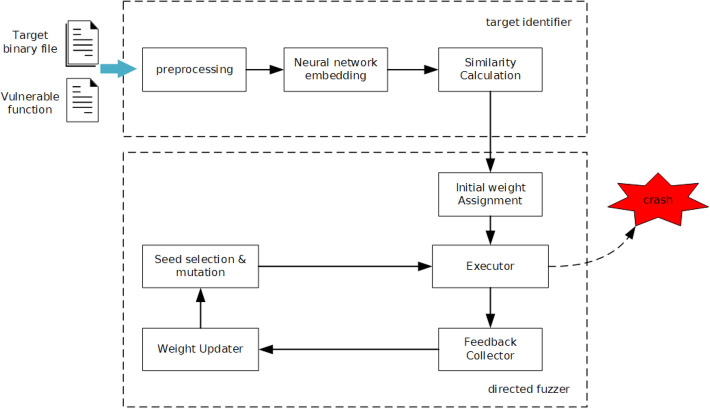
Directed greybox fuzzing (DGF) is an effective method to detect vulnerabilities of the specified target code. Nevertheless, there are three main issues in the existing DGFs. First, the target vulnerable code of the DGFs needs to be manually selected, which is tedious. Second, DGFs mainly leverage distance information as feedback, which neglects the unequal roles of different code snippets in reaching the targets. Third, most of the existing DGFs need the source code of the test programs, which is not available for binary programs. In this paper, we propose a vulnerability-oriented directed binary fuzzing framework named VDFuzz, which automatically identifies the targets and leverages dynamic information to guide the fuzzing. In specific, VDFuzz consists of two components, a target identifier and a directed fuzzer. The target identifier is designed based on a neural-network, which can automatically locate the target code areas that are similar to the known vulnerabilities. Considering the inequality of code snippets in reaching the given target, the directed fuzzer assigns different weights to basic blocks and takes the weights as feedback to generate test cases to reach the target code. Experimental results demonstrate that VDFuzz outperformed the state-of-the-art fuzzers and was effective in vulnerability detection of real-world programs.
§ The Valyu brief
Reading the full paper and taking notes. This takes a few seconds…
§ Ask this paper
Ask a question about this paper
Valyu reads the full text and answers from what the paper actually says.
Searching the other archives…