Body and the Senses in Spatial Experience: The Implications of Kinesthetic and Synesthetic Perceptions for Design Thinking
Jain Kwon, Alyssa Iedema
Abstract
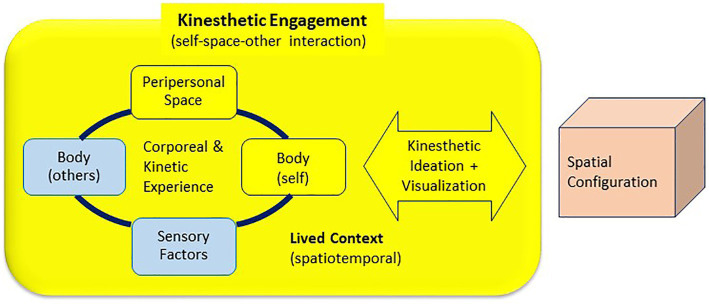
Human perception has long been a critical subject of design thinking. While various studies have stressed the link between thinking and acting, particularly in spatial experience, the term “design thinking” seems to disconnect conceptual thinking from physical expression or process. Spatial perception is multimodal and fundamentally bound to the body that is not a mere receptor of sensory stimuli but an active agent engaged with the perceivable environment. The body apprehends the experience in which one’s kinesthetic engagement and knowledge play an essential role. Although design disciplines have integrated the abstract, metaphoric, and visual aspects of the body and its movement into conceptual thinking, studies have pointed out that design disciplines have emphasized visuality above the other sensory domains and heavily engaged with the perception of visual configurations, relying on the Gestalt principles. Gestalt psychology must be valued for its attention to a whole. However, the theories of design elements and principles over-empathizing such visuality posit the aesthetics of design mainly as visual value and understate other sensorial and perceptual aspects. Although the visual approach may provide a practical means to represent and communicate ideas, a design process heavily driven by visuality can exhibit weaknesses undermining certain aspects of spatial experience despite the complexity. Grounded in Merleau-Ponty’s notion of multisensory perception, this article discusses the relationship between body awareness and spatial perception and its implication for design disciplines concerning built environments. Special attention is given to the concepts of kinesthetic and synesthetic phenomena known as multisensory and cross-sensory, respectively. This discussion integrates the corporeal and spatiotemporal realms of human experience into the discourse of kinesthetic and synesthetic perceptions. Based on the conceptual, theoretical, and precedent analyses, this article proposes three models for design thinking: Synesthetic Translation, Kinesthetic Resonance, and Kinesthetic Engagement.
§ The Valyu brief
Reading the full paper and taking notes. This takes a few seconds…
§ Ask this paper
Ask a question about this paper
Valyu reads the full text and answers from what the paper actually says.
Searching the other archives…