Modelling clinical DNA fragmentation in the development of universal PCR-based assays for bisulfite-converted, formalin-fixed and cell-free DNA sample analysis
Andrew D. Johnston, Jennifer Lu, Darren Korbie, Matt Trau
Abstract
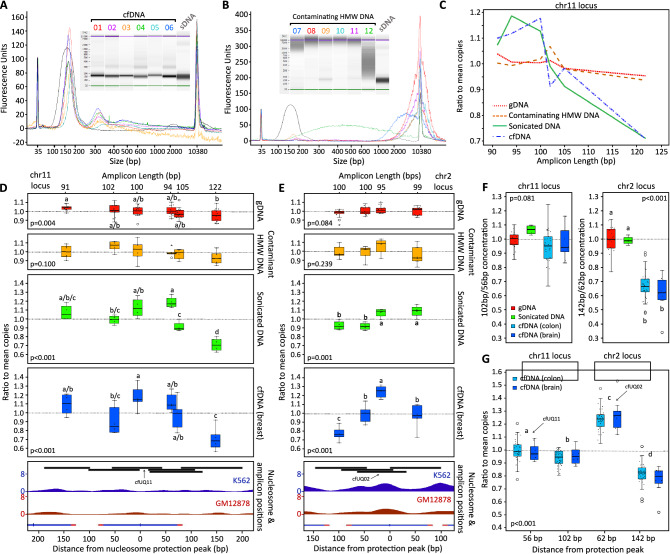
In fragmented DNA, PCR-based methods quantify the number of intact regions at a specific amplicon length. However, the relationship between the population of DNA fragments within a sample and the likelihood they will amplify has not been fully described. To address this, we have derived a mathematical equation that relates the distribution profile of a stochastically fragmented DNA sample to the probability that a DNA fragment within that sample can be amplified by any PCR assay of arbitrary length. Two panels of multiplex PCR assays for quantifying fragmented DNA were then developed: a four-plex panel that can be applied to any human DNA sample and used to estimate the percentage of regions that are intact at any length; and a two-plex panel optimized for quantifying circulating cell-free DNA (cfDNA). For these assays, regions of the human genome least affected by copy number aberration were identified and selected; within these copy-neutral regions, each PCR assay was designed to amplify both genomic and bisulfite-converted DNA; and all assays were validated for use in both conventional qPCR and droplet-digital PCR. Finally, using the cfDNA-optimized assays we find evidence of universally conserved nucleosome positioning among individuals.
§ The Valyu brief
Reading the full paper and taking notes. This takes a few seconds…
§ Ask this paper
Ask a question about this paper
Valyu reads the full text and answers from what the paper actually says.
Searching the other archives…