Standardized Description of the Feature Extraction Process to Transform Raw Data Into Meaningful Information for Enhancing Data Reuse: Consensus Study
Christian Lovis, Jennifer Hefner, Martin Sedlmayr, Francisco Maria Calisto, Emmanuelle Sylvestre, Antoine Lamer, Mathilde Fruchart, Nicolas Paris, Benjamin Popoff, Anaïs Payen, Thibaut Balcaen, William Gacquer, Guillaume Bouzillé, Marc Cuggia, Matthieu Doutreligne, Emmanuel Chazard
Abstract
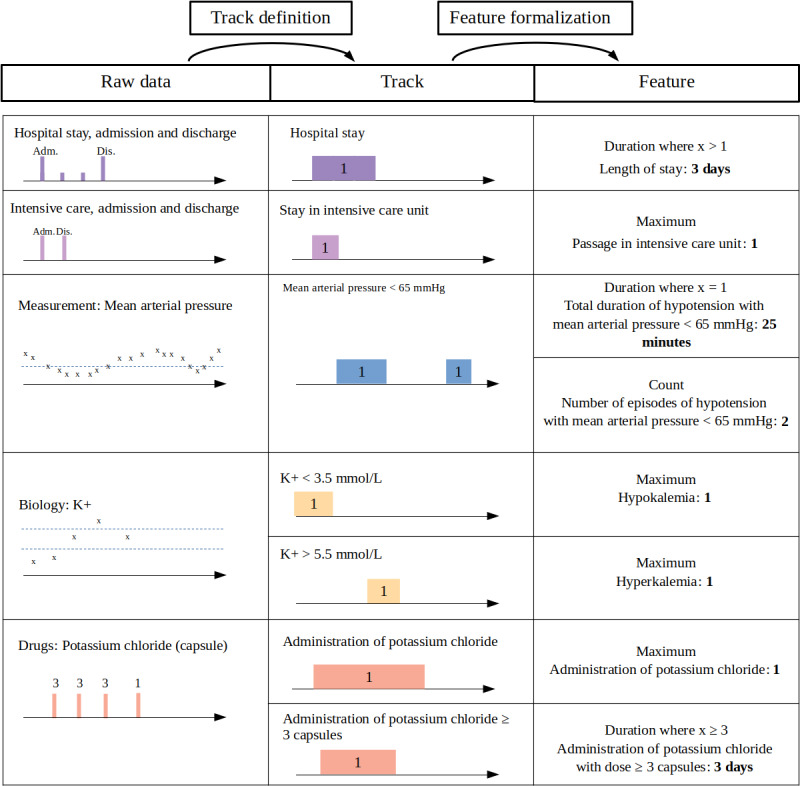
Background Despite the many opportunities data reuse offers, its implementation presents many difficulties, and raw data cannot be reused directly. Information is not always directly available in the source database and needs to be computed afterwards with raw data for defining an algorithm. Objective The main purpose of this article is to present a standardized description of the steps and transformations required during the feature extraction process when conducting retrospective observational studies. A secondary objective is to identify how the features could be stored in the schema of a data warehouse. Methods This study involved the following 3 main steps: (1) the collection of relevant study cases related to feature extraction and based on the automatic and secondary use of data; (2) the standardized description of raw data, steps, and transformations, which were common to the study cases; and (3) the identification of an appropriate table to store the features in the Observation Medical Outcomes Partnership (OMOP) common data model (CDM). Results We interviewed 10 researchers from 3 French university hospitals and a national institution, who were involved in 8 retrospective and observational studies. Based on these studies, 2 states (track and feature) and 2 transformations (track definition and track aggregation) emerged. “Track” is a time-dependent signal or period of interest, defined by a statistical unit, a value, and 2 milestones (a start event and an end event). “Feature” is time-independent high-level information with dimensionality identical to the statistical unit of the study, defined by a label and a value. The time dimension has become implicit in the value or name of the variable. We propose the 2 tables “TRACK” and “FEATURE” to store variables obtained in feature extraction and extend the OMOP CDM. Conclusions We propose a standardized description of the feature extraction process. The process combined the 2 steps of track definition and track aggregation. By dividing the feature extraction into these 2 steps, difficulty was managed during track definition.
§ The Valyu brief
Reading the full paper and taking notes. This takes a few seconds…
§ Ask this paper
Ask a question about this paper
Valyu reads the full text and answers from what the paper actually says.
Searching the other archives…